Most apps treat localization like a translation job. Teams copy English metadata into Google Translate, paste the results into the store, and then wonder why downloads do not grow. The problem is not only words, it is the approach.
Real localization aligns three things: how people search in a market, what they expect to see on your product page, and what your app delivers after install. When these three match, relevance improves, real users tap and install, and organic visibility rises. This guide shows how to make that happen.
What ASO Localization Actually Means
Translation swaps words. Localization captures demand. Proper localization matches local search behavior, cultural expectations, and an in-app experience that feels native. That requires rethinking metadata, redesigning creatives, and adapting the product experience for each market.
Metadata includes title and subtitle on iOS, the keywords field on iOS, and description fields on Android. Creatives include screenshots, captions, and preview videos. Localization also lives inside the app. Language coverage matters, currency formats matter, payment flows and seasonal messaging matter. The goal is relevance that converts.
Pick Markets That Make Sense
You cannot localize everywhere at once. Score each potential market on three criteria.
- Demand. Are people searching for your category in that language? Check category rankings, competitor presence, and store search suggestions.
- Friction. How hard is it to serve this market well? Consider current language support, payment methods, and regulatory specifics.
- Strategic fit. Does the market share language or culture with places you already serve?
Score from zero to five for each factor. Start with two or three markets that show high demand and low friction so early wins are visible.
Research How People Actually Search
Good localization starts with real query behavior. This is not about translating English keywords, it is about discovering what people type when they look for solutions like yours.
Use store auto complete in the local language. Capture variants, synonyms, and colloquialisms. Note English loanwords where relevant.
Review competitor storefronts. Record titles and subtitles, track repeated phrases, and capture messaging patterns. Leaders often emphasize different benefits by country.
Watch for language subtleties. Some markets use transliteration or mixed scripts, some prefer formal phrasing while others prefer colloquial phrasing.
Mine your analytics to see which features drive outcomes, then research how locals describe those outcomes.
Turn findings into an intent map with clusters such as budgeting, family planning, or workout tracking, and list head terms, modifiers, and long-tail phrases for each locale.
Build Your Semantic Core Per Market
The semantic core powers localized metadata. For each target market define:
Head terms that match how locals name your category.
Mid-tail modifiers for features and outcomes such as offline mode, for teams, or invoice scanner.
Long-tail problem statements and colloquialisms you are comfortable targeting.
Variants such as gendered nouns, pluralization, script changes, and spacing conventions.
Group keywords into clusters that map to the user journey and to your product value. Let these clusters guide both metadata and creative narratives.
Write Metadata That Converts Locally
Localized metadata must increase relevance and explain value instantly.
Title. Lead with category and your strongest value proposition in natural local phrasing. Keep the brand recognizable. Avoid obvious stuffing, it hurts readability and may reduce performance.
Subtitle or short description. Turn the sharpest cluster into a clear benefit statement. Compress meaning without losing clarity.
Keywords field on iOS or full description on Android. Use mid-tail and long-tail terms and avoid wasteful repetition of words already present in title or subtitle. Surface the forms users actually type.
Tone matters. Direct claims work in some cultures and feel aggressive in others. Adjust tone to local norms and you often gain conversion.
Localize Creatives That Speak Locally
Screenshots and video often move conversion more than text.
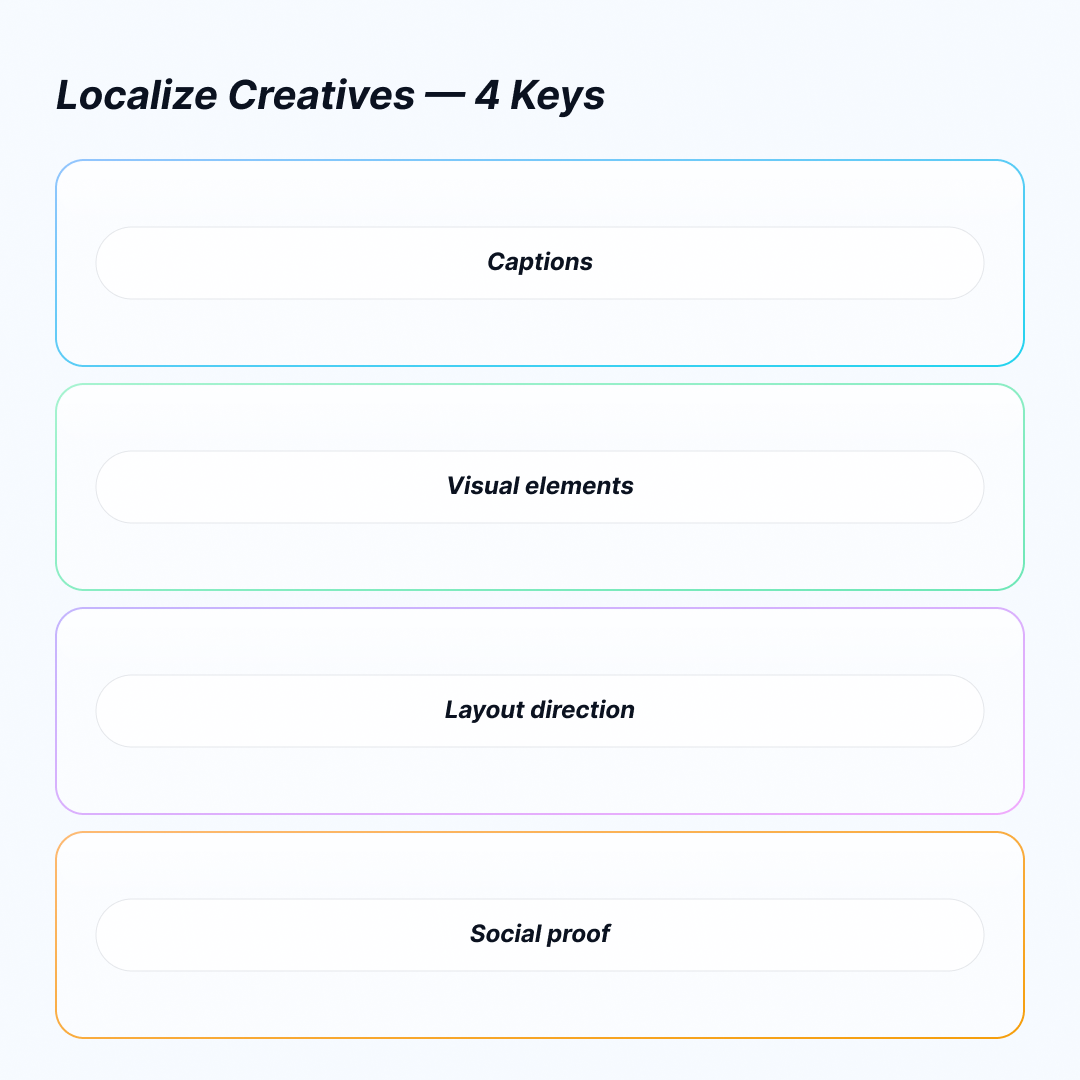
Captions. Translate meaning, not letters. Keep the pattern of benefit, proof, and next step. Adjust numeral spacing, decimal separators, and date formats.
Visual elements. Use local currency symbols, familiar payment methods, recognizable maps, or everyday items. Avoid foreign or stereotypical imagery.
Layout direction. For right-to-left languages mirror layouts so flows feel native.
Social proof. Localize ratings and review snippets when available. If local reviews are limited, use credible global proof with clear context.
Treat each locale like a creative test. Tell one story per intent cluster per product page. Too many themes at once dilute the message.
Match the In-App Experience to Your Promise
Organic growth stalls when the app feels foreign after install. Users expect consistency between the product page and the product.
Prioritize language coverage for onboarding, paywall, and core features.
Get pricing and currency right. Use local separators, show taxes where expected, and choose price points that fit local psychology.
Localize support and lifecycle content, including push notifications, help center, and receipts.
Consider cultural moments such as holidays or seasonal use cases. Timely content can improve word of mouth and may help eligibility for editorial consideration.
When the post-install experience matches the storefront promise, ratings stabilize and conversion reinforces itself.
Connect Apple Search Ads to Your ASO Strategy
ASO localization accelerates when connected to Apple Search Ads.
Discover intent with exploratory ad groups that use Search Match and broad match. Pause weak terms quickly and promote strong terms to exact match.
Test messaging with Custom Product Pages. Create one page per intent cluster and keep promise, proof, and call to action consistent from keyword to ad to page.
Lock in wins by folding successful phrasing into subtitle or the iOS keywords field so organic relevance benefits from paid learnings.
Allocate the budget wisely. Protect brand terms efficiently and invest exploration into generic and competitor intent where learnings are largest.
Close the loop with weekly search term reviews and updates to the semantic core.
This loop often lowers blended acquisition cost because better relevance improves paid tap through and install rates, and stronger storefronts support sustained organic visibility.
Launch in Phases and Read the Data
Ship in measured steps and read data cleanly.
Start with metadata and one creative set per locale, then add more pages after clear wins.
Track the full funnel from impressions to product page views to tap through rate to conversion rate to install to retained users. For paid, read tap through first, then conversion, then cost.
Monitor organic signals such as keyword ranks by cluster, browse visibility, and share of category impressions. Use moving averages to reduce noise.
Test responsibly. If you suspect cannibalization, run brand holdouts or blended curves to judge market level impact.
Set guardrails. Cap test duration, stop early when a variant hurts conversion, and time metadata updates alongside steady, relevant traffic so results are interpretable.
Iterate weekly on copy and update creative themes monthly. To avoid constant churn, stores need stable signals to recalibrate relevance.
Mistakes to Avoid
Literal keyword translation that ignores local query behavior. Always validate with auto complete and live query data.
Too many product pages that create noisy signals. Begin with one Custom Product Page per cluster and add only after clear wins.
Changing everything at once which hides the cause of movement. Change one major variable per window.
Ignoring reviews and responses. Localize replies and collect local ratings intentionally.
Poor pricing localization with awkward formats or price points.
Pre-Launch Checklist
Market selected for strong demand and manageable friction.
Basic in-app localization complete for onboarding, paywall, and core flows.
Intent map and semantic core finalized for the locale.
Title, subtitle, and keywords or descriptions localized for meaning and local search behavior.
One localized creative narrative per intent cluster, layouts mirrored for right-to-left where needed.
Reviews strategy and support flows localized.
Pricing and currency validated.
Apple Search Ads groups ready to test and learn, Custom Product Pages mapped to clusters.
Measurement plan with guardrails and success thresholds.
FAQ
What Does ASO Localization Actually Mean?
It’s not translation; it’s market fit. True localization aligns how people search, what your store page promises, and what the app delivers after install. That means rethinking metadata, creatives, tone, pricing, and in-app flows so everything feels native and converts.
Which Markets Should I Localize First?
Score countries by Demand, Friction, and Strategic Fit. Use category rankings, search suggestions, competitor presence, language/payment readiness, and cultural proximity. Start with two or three high-demand, low-friction markets to prove lift fast.
How Do I Find Real Local Queries And Build A Semantic Core?
Research native behavior via store autocomplete, competitor titles/subtitles, and local phrasing, including loanwords and transliteration. Cluster intents and capture head, mid-tail, and long-tail terms with variants like gender, plurality, and scripts. This semantic core drives both metadata and creative narratives.
How Do I Write Metadata And Creatives That Convert Locally?
Title should pair category with your sharpest value in natural phrasing; subtitle distills the top intent into a clear benefit. Use iOS keywords/Android description for mid- and long-tail without wasteful repetition; match local tone. Localize captions, currencies, numerals, dates, and payment cues; mirror layouts for RTL.
It’s not translation; it’s market fit. True localization aligns how people search, what your store page promises, and what the app delivers after install. That means rethinking metadata, creatives, tone, pricing, and in-app flows so everything feels native and converts.
Which Markets Should I Localize First?
Score countries by Demand, Friction, and Strategic Fit. Use category rankings, search suggestions, competitor presence, language/payment readiness, and cultural proximity. Start with two or three high-demand, low-friction markets to prove lift fast.
How Do I Find Real Local Queries And Build A Semantic Core?
Research native behavior via store autocomplete, competitor titles/subtitles, and local phrasing, including loanwords and transliteration. Cluster intents and capture head, mid-tail, and long-tail terms with variants like gender, plurality, and scripts. This semantic core drives both metadata and creative narratives.
How Do I Write Metadata And Creatives That Convert Locally?
Title should pair category with your sharpest value in natural phrasing; subtitle distills the top intent into a clear benefit. Use iOS keywords/Android description for mid- and long-tail without wasteful repetition; match local tone. Localize captions, currencies, numerals, dates, and payment cues; mirror layouts for RTL.
Making It Work
ASO localization compounds because it creates focus. You choose the outcome you’re claiming, learn how people in each market describe that outcome, and pick the kind of proof that actually triggers an install. That focus makes your metadata sharper, your creatives more convincing, and the in-app experience feel trustworthy.
The payoff is durable organic traffic, a lower blended acquisition cost, and a repeatable way to expand into the next country. Start small: pick two markets, build one narrative per cluster, change one variable at a time, ship, measure, and iterate. After a quarter of disciplined cycles, you’ll have a localization system that feels native wherever you launch.
The payoff is durable organic traffic, a lower blended acquisition cost, and a repeatable way to expand into the next country. Start small: pick two markets, build one narrative per cluster, change one variable at a time, ship, measure, and iterate. After a quarter of disciplined cycles, you’ll have a localization system that feels native wherever you launch.