
If you own installs, revenue, or rankings, this is your map. ASO 2026 focuses on what truly moves outcomes. Use it end-to-end if you are building from scratch, or jump to the parts you need and ship wins today.
What Is ASO in 2026
ASO has three jobs. Help people find your app. Convince them to download it. Measure and improve both with data. Keyword work without conversion is wasted effort because traffic leaks out. Analytics only matter when they reflect real user behavior.
Platform updates worth noting:
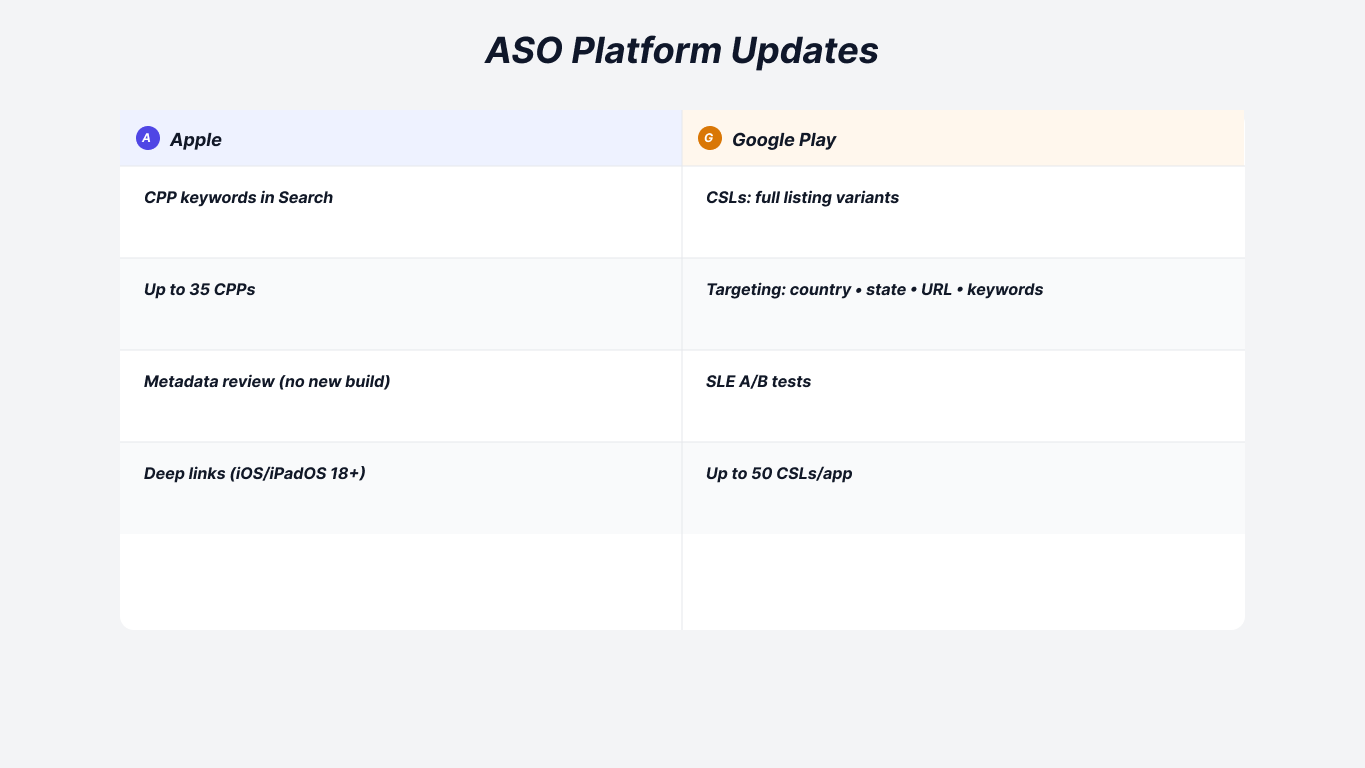
Apple: You can assign keywords to Custom Product Pages, allowing those pages to appear in search results instead of the default product page. You can create up to 35 Custom Product Pages per app. You can submit new updates to review without a new build release. Custom Product Pages support deep links that can open app destinations on iOS and iPadOS 18 and later.
Google Play: Custom Store Listings allows you to build a complete listing based on country, user status, URL, and search keywords for each country for which you have a Custom Store Listing. Store Listing Experiments allows you to conduct native tests on primary or custom listings. Up to 50 CSLs per app with the above targeting options.
Google Play: Custom Store Listings allows you to build a complete listing based on country, user status, URL, and search keywords for each country for which you have a Custom Store Listing. Store Listing Experiments allows you to conduct native tests on primary or custom listings. Up to 50 CSLs per app with the above targeting options.
Also remember: over 70% of App Store visitors use search to discover apps, which is why intent alignment matters.
Understanding App Store Algorithms
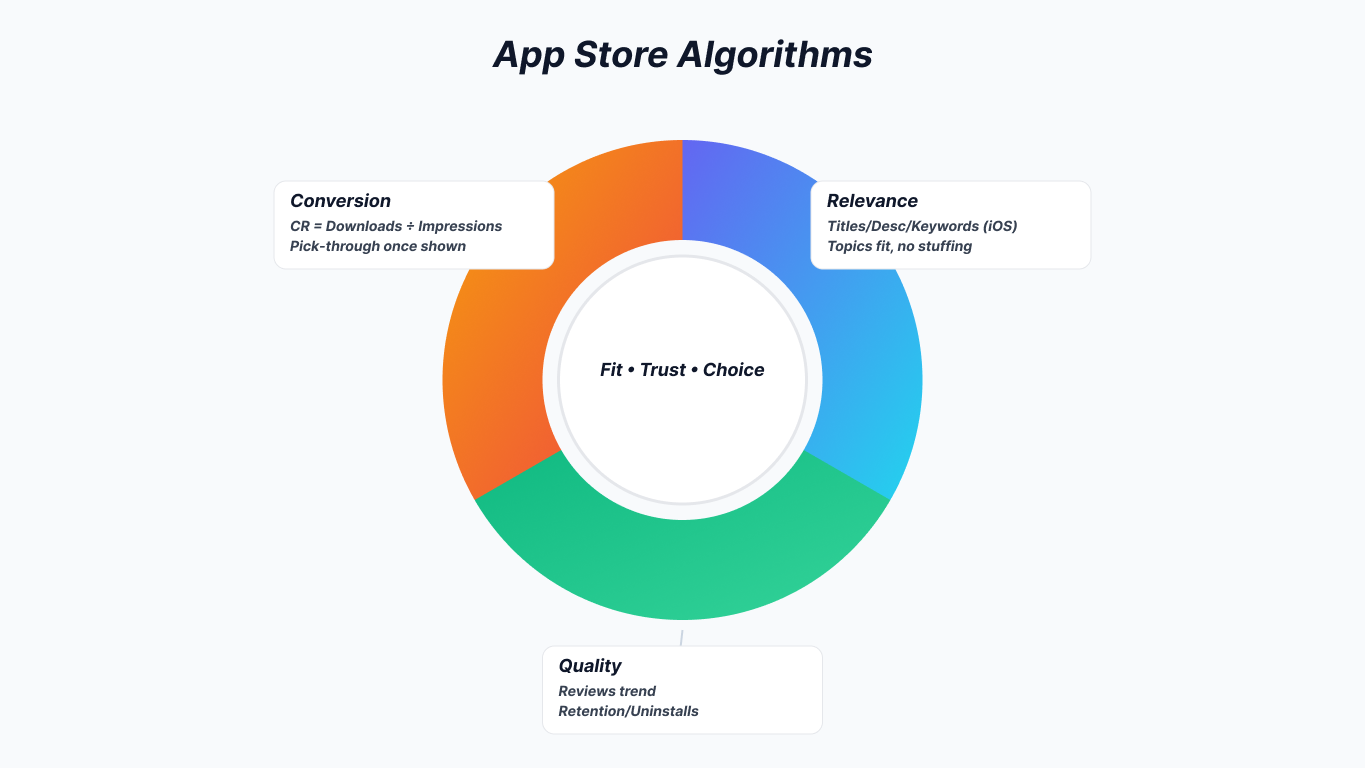
Relevance determines whether your text is on the correct topics and whether your text is in the right places. Use the app name, subtitle, or short description, long description, and, on iOS, the keywords field. Don't use stuffing.
Quality measures recent reviews, rating trends, stability, and product health metrics, such as retention and uninstalls, as well as the over-time buoyancy of your app score.
Conversion refers to how well searchers select you when you appear in search results. The introductory rate in App Store Connect is Total Downloads divided by Unique Impressions. Use the exact definition throughout your reports for ease.
Quality measures recent reviews, rating trends, stability, and product health metrics, such as retention and uninstalls, as well as the over-time buoyancy of your app score.
Conversion refers to how well searchers select you when you appear in search results. The introductory rate in App Store Connect is Total Downloads divided by Unique Impressions. Use the exact definition throughout your reports for ease.
Building Your Keyword Strategy
Begin with your market. Analyze category size, leading competitors, and real queries.
Search queries reveal user intent: informational (“What is a budget?”), navigational (“Budget app”), transactional (“Best budget app”), or commercial (“Bill reminder app”).
Start with seed keywords tied to your core jobs to be done. Study the top apps in your category, expand into adjacent and long-tail terms, then group keywords by intent and journey stage. Prioritize them by search volume, difficulty, and conversion potential.
Search queries reveal user intent: informational (“What is a budget?”), navigational (“Budget app”), transactional (“Best budget app”), or commercial (“Bill reminder app”).
Start with seed keywords tied to your core jobs to be done. Study the top apps in your category, expand into adjacent and long-tail terms, then group keywords by intent and journey stage. Prioritize them by search volume, difficulty, and conversion potential.
- For iOS, in the app name and subtitle, place emphasis on primary terms. Use the keywords field to develop strategic combinations. Design Custom Product Pages for intent-rich queries. Assign relevant keywords to each page to ensure it can be discovered for those terms. Make inter-page combinations distinct to minimize the risk of internal redundancy.
- For Google Play, use a more conversational tone in the app name and descriptions. Use simpler terms instead of being repetitive. Adhere to the guidelines.
Localization is an investment with uneven returns. Prioritize these markets with obvious high potential.
User Segmentation and Targeting
Different users need different messages: power users want depth, casual users simplicity, value users better pricing, and feature users specific capabilities.
Match the message to the buyer stage: educate problem-aware users, prove value to solution-aware users, highlight benefits for product-aware users, and give purchase-ready users a clear next step.
Create custom store pages for key segments, track performance, and invest more in the audiences that convert best.
Match the message to the buyer stage: educate problem-aware users, prove value to solution-aware users, highlight benefits for product-aware users, and give purchase-ready users a clear next step.
Create custom store pages for key segments, track performance, and invest more in the audiences that convert best.
Writing Metadata That Converts
App Store iOS
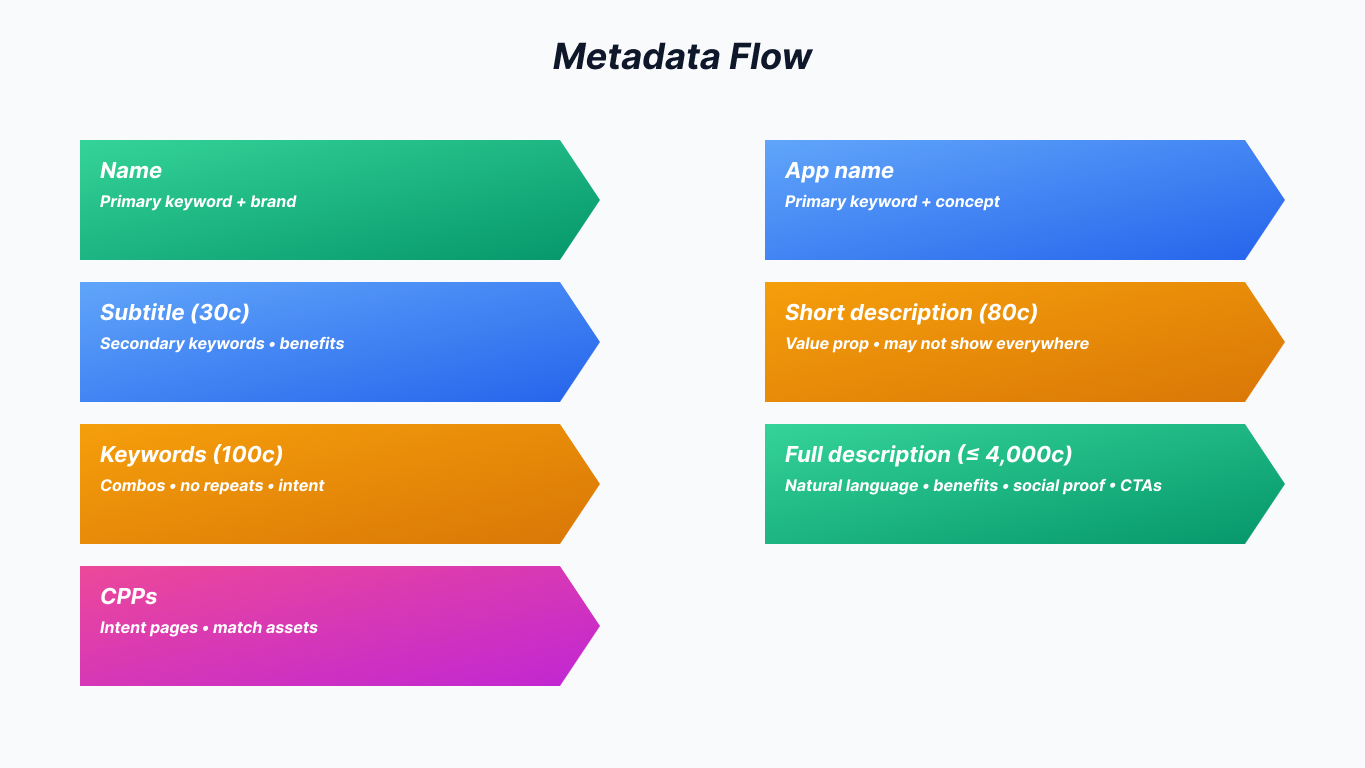
Integrate the app name with the primary keyword. Assign the subtitle to secondary keywords and a concise, unique proposition. Fill the keywords field with strategic combinations of keywords.
Avoid repeating the exact words in different fields. Create intent-specific Custom Product Pages and align them with search terms and accompanying screenshots.
Avoid repeating the exact words in different fields. Create intent-specific Custom Product Pages and align them with search terms and accompanying screenshots.
Google Play
Focus the app name on the concept and primary term as its "absolute" strategic term. Craft an 80-character short description that is readable and user-friendly. The rest of the description should elaborate on benefits, features, proof, and the call to action. Ensure the language is conversational.
Advanced Visual Assets
The icon should stay clear at small sizes and fit the category. Test distinct concepts, not just color variations, and consider cultural differences across markets.
Screenshots should tell a story: lead with the core value, show the transformation, highlight 2–3 key features, add social proof, and finish with a clear CTA.
Use video where motion explains more than a static image. Design for silent playback and instant understanding, especially for iOS previews and Google Play promo videos.
Screenshots should tell a story: lead with the core value, show the transformation, highlight 2–3 key features, add social proof, and finish with a clear CTA.
Use video where motion explains more than a static image. Design for silent playback and instant understanding, especially for iOS previews and Google Play promo videos.
Аpp Performance Analytics
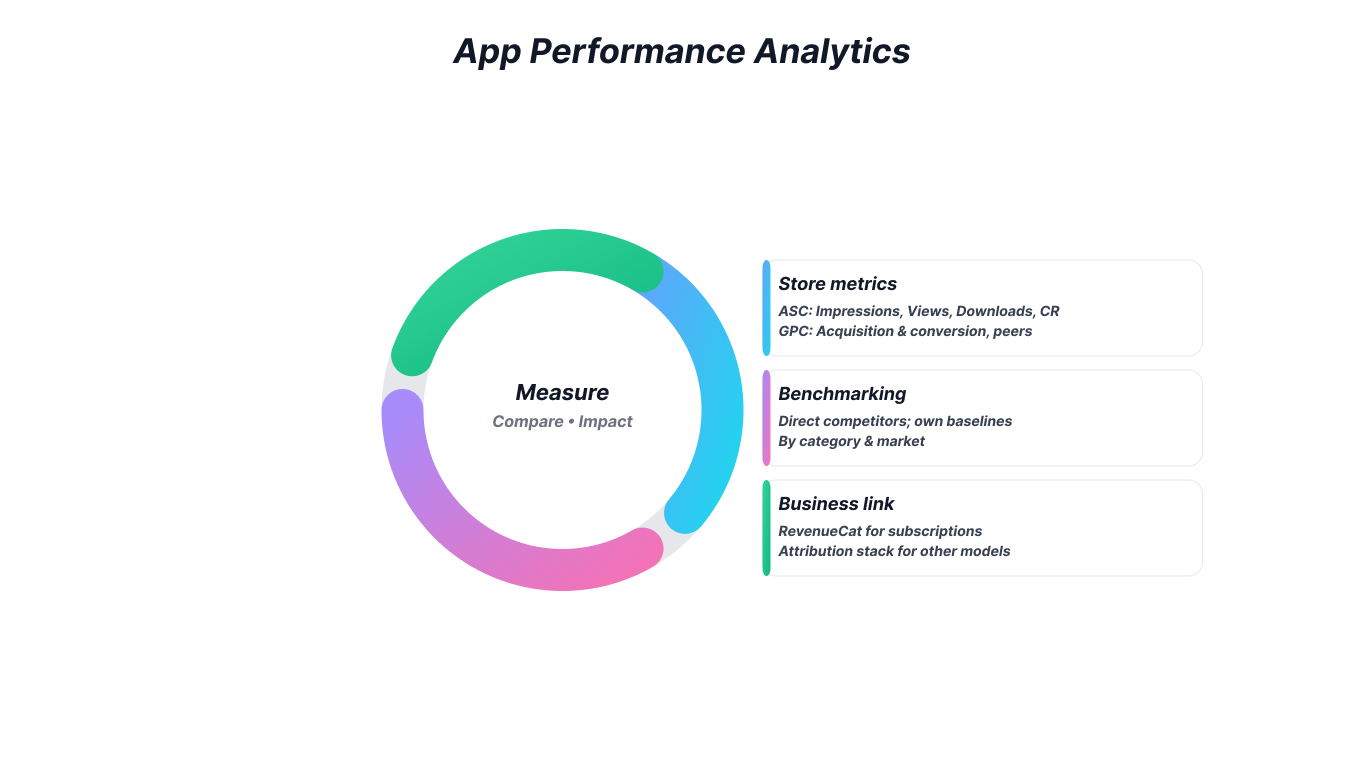
- In App Store Connect, follow along with Unique Impressions, Product Page Views, Total Downloads, and Conversion Rate metrics. Differentiate by data source and by page type, like default or Custom Product Page.
- In Google Play Console, split acquisition and conversion data by country, surface, and listing. Use peer benchmarks for context.
Link store metrics to revenue and retention using your preferred attribution stack or tools like RevenueCat. Don't apply global rules, and design your own benchmarks.
Competitive Intelligence
Monitor competitors and key icons, taking screenshots and recording videos to track changes. Track the ranking changes of those competitors. Monitor gaps and seasonal opportunities. Separate competitors into direct, indirect, adjacent, and emerging threats. Protect your brand terms. Place your offers around your strengths and their weaknesses.
Monetization Strategy Impact
Freemium offers require the least resistance and the most clear immediate free value. Make it easy to optimize trial gates and highlight the moments to upgrade.
Benefits must generate additional revenue and need to be ongoing for subscriptions. One-time purchases need strong proof and a clear cost-benefit that can be justified.
Purchases within the app must have a clearly defined path to and value core without requiring a purchase.
Benefits must generate additional revenue and need to be ongoing for subscriptions. One-time purchases need strong proof and a clear cost-benefit that can be justified.
Purchases within the app must have a clearly defined path to and value core without requiring a purchase.
Managing Ratings and Reviews
Alongside review analysis, develop your roadmap and store messaging. Examine review content to monitor and celebrate usage milestones. Following a joyous support moment, requests for a review.
Critique the review and respond to the review. Sixteen silos respond to support that needs to be segregated. Global and Regional reply templates geo-respond to the top few GPR markets that both sets need to apply to.
Critique the review and respond to the review. Sixteen silos respond to support that needs to be segregated. Global and Regional reply templates geo-respond to the top few GPR markets that both sets need to apply to.
Growth Marketing Integration
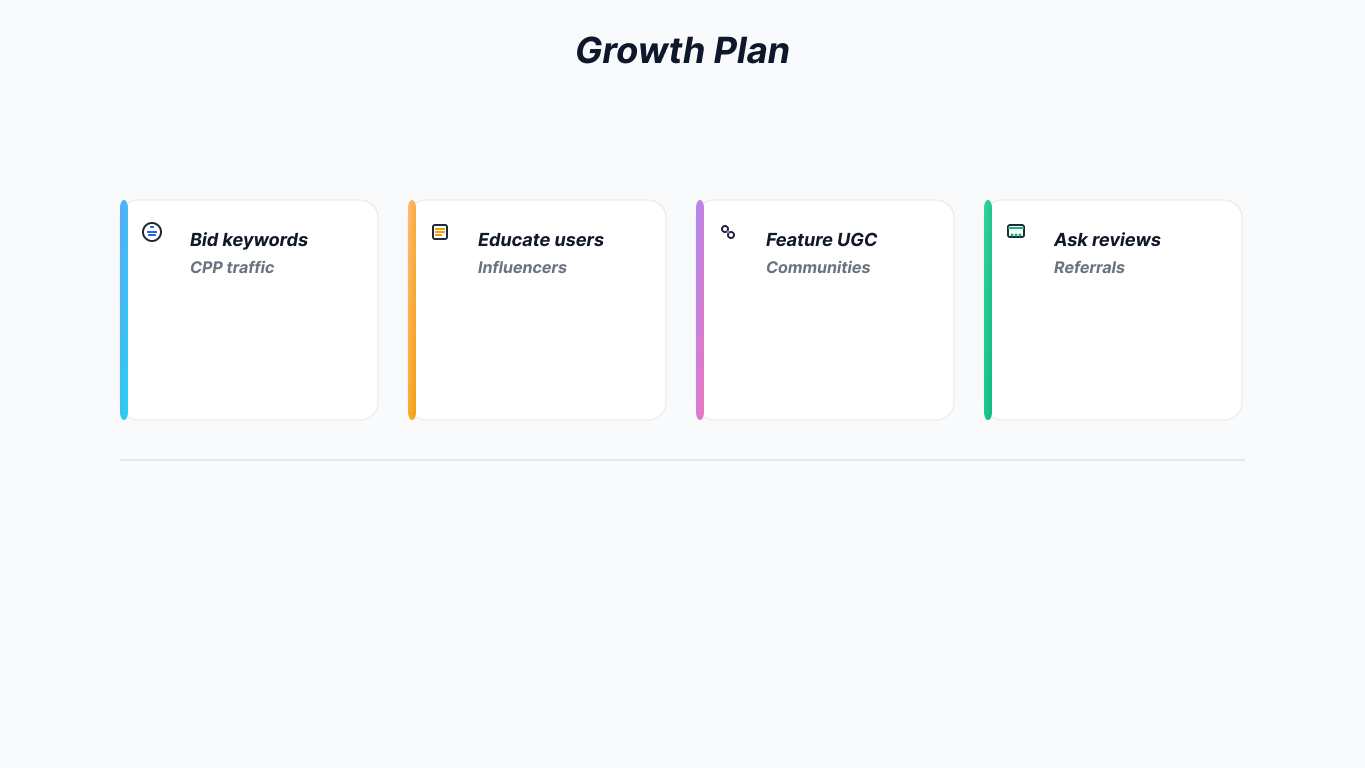
Paid targeted marketing should be aligned and planned with ASO. In the common search areas for Apple and Google, the exact keywords should be targeted. Cross-ad creative must align with listing messaging. Each paid ad must direct to a corresponding custom landing page. Each paid page must be assigned an influence on the organic traffic page.
ASO content must be supplemented with outbound links. Answer the same intent with web pages. Use influencer content to write product education stories. Launch feature re-engagement campaigns. Use email for review prompts.
ASO content must be supplemented with outbound links. Answer the same intent with web pages. Use influencer content to write product education stories. Launch feature re-engagement campaigns. Use email for review prompts.
Advanced Localization
Analyze potential new markets based on the dimensions of category size, competition, purchasing ability, and effort required for localization. Reorient screenshots for right-to-left reading.
Observe relevant color and cultural etiquette. Pivot the focus of emphasis to that market's predominant interests. Translate and use local testimonials. Develop a keyword strategy tailored to each country and implement it at the regional level.
On iOS, customize and localize Custom Product Pages. On Google Play, apply Custom Store Listings by country, user state, or use targeted search terms.
Observe relevant color and cultural etiquette. Pivot the focus of emphasis to that market's predominant interests. Translate and use local testimonials. Develop a keyword strategy tailored to each country and implement it at the regional level.
On iOS, customize and localize Custom Product Pages. On Google Play, apply Custom Store Listings by country, user state, or use targeted search terms.
Testing and Optimization
How do you determine what creates a first impression? Icon. First screenshot. App name when it is marketable. Plan experiments by minimum detectable effect and power. In Product Page Optimization, Apple allocates a specific time, and you may run extended tests when necessary.
On Google Play, perform Store Listing Experiments on primary or secondary listings and then deploy the winning variant.
On Google Play, perform Store Listing Experiments on primary or secondary listings and then deploy the winning variant.
iOS Custom Product Pages
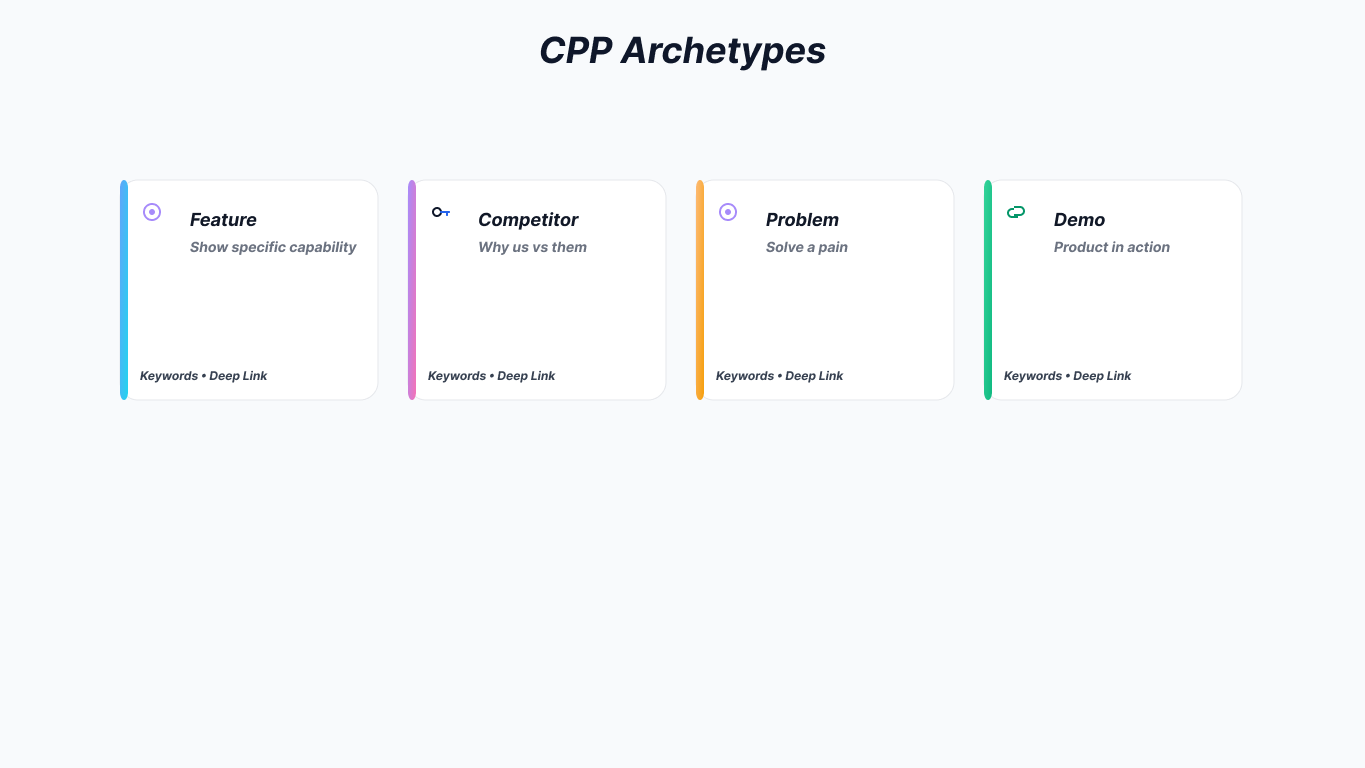
Create pages for features, competitor comparisons, problem-solution stories, and product demos. Assign the keywords from your latest approved version. Ensure that each combination is unique to a single page.
Pages become searchable after approval and once visibility is enabled. You can edit and resubmit without needing to start a new build from scratch. You can add deep links so that the Open action can direct users to a specific page on recent versions of iOS.
Be careful of internal cannibalization. If Custom Product Page impressions increase at the expense of the default page for the same intent, with total installs remaining stagnant, then you need to rework the keyword frameworks and creative focus.
Pages become searchable after approval and once visibility is enabled. You can edit and resubmit without needing to start a new build from scratch. You can add deep links so that the Open action can direct users to a specific page on recent versions of iOS.
Be careful of internal cannibalization. If Custom Product Page impressions increase at the expense of the default page for the same intent, with total installs remaining stagnant, then you need to rework the keyword frameworks and creative focus.
Google Play Optimization
Evaluate and test icons, first screenshots, and names using Store Listing Experiments. When possible, segment by locale. Use Custom Store Listings by country, user state, URL, or keyword to tailor narratives. Avoid Overlap and maintain a clean mapping from intent to listing.
Advanced Analytics
Utilize only store-supported data to track the journey from impression to install to retention. The model is expected to improve lift by intent and rank the experiments based on their impact on revenue and lifetime value.
Team Structure
The ASO manager owns the strategy and the testing roadmap. Creative leads icons, screenshots, and video. Data analysts reporting, competitive tracking, and experiment readouts.
Content leads to metadata, localization, and reviews. What product partners bring store learnings back to the roadmap? Meet weekly to review results, select the following tests, and document hypotheses and outcomes. Keep version control for assets and messages.
Content leads to metadata, localization, and reviews. What product partners bring store learnings back to the roadmap? Meet weekly to review results, select the following tests, and document hypotheses and outcomes. Keep version control for assets and messages.
Category-Specific Approaches
Games should show real gameplay and clear progression. Highlight the community where it matters.
Productivity should be demonstrated through both before-and-after time savings and its integration with popular tools.
Lifestyle and health should demonstrate tangible outcomes, and relevant health experts or medical evidence should be provided. Address sensitive and privacy issues with the data.
Finance must focus on security, compliance, and provide eloquent, quantified value. Insert added bank partners and badges where applicable.
Productivity should be demonstrated through both before-and-after time savings and its integration with popular tools.
Lifestyle and health should demonstrate tangible outcomes, and relevant health experts or medical evidence should be provided. Address sensitive and privacy issues with the data.
Finance must focus on security, compliance, and provide eloquent, quantified value. Insert added bank partners and badges where applicable.
Future-Proofing Your Strategy
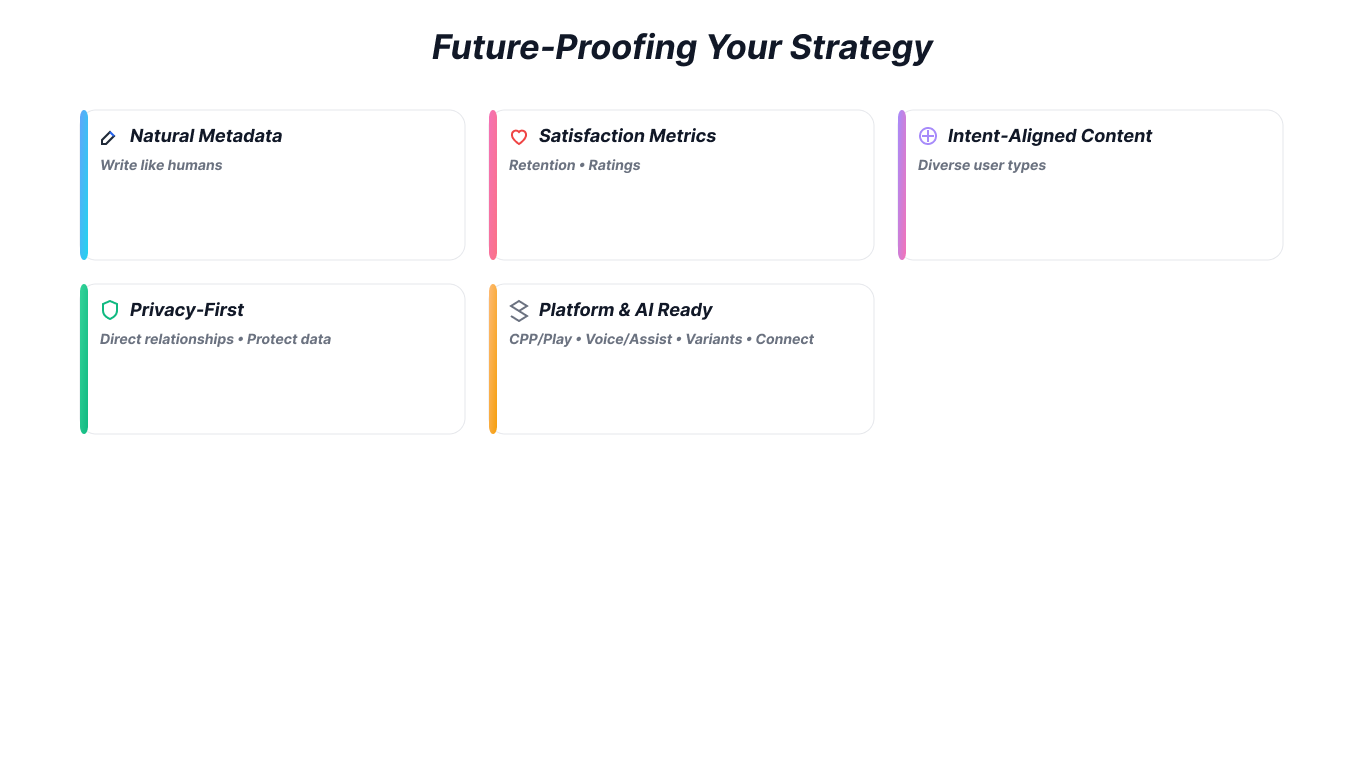
Write like a person and genuinely aim to maximize satisfaction. Anticipate New Store surfaces and expanded Custom Product Page capabilities.
Get ready for discovery through voice and assistants, as well as passively. Use AI to produce and test variations, but ensure a human scrutineer is involved. Trust is earned via privacy and proprietary feedback systems.
Get ready for discovery through voice and assistants, as well as passively. Use AI to produce and test variations, but ensure a human scrutineer is involved. Trust is earned via privacy and proprietary feedback systems.
Crisis Management
In the event of a ranking drop, first assess whether it is due to an algorithm change, competition, or internal quality issues. Resolve technical and policy issues first.
Quality improvement and slow rebuilding are advised. Use of a single keyword is not recommended. When a wave of negative reviews comes, focus on real problems, report abuse, and activate your general users. Regularly review your guidelines and ensure that you conduct a preflight check before every submission.
Quality improvement and slow rebuilding are advised. Use of a single keyword is not recommended. When a wave of negative reviews comes, focus on real problems, report abuse, and activate your general users. Regularly review your guidelines and ensure that you conduct a preflight check before every submission.
Essential Tools
- Use these analytics platforms: AppTweak, Sensor Tower, Mobile Action, App Annie.
- Manage through App Store Connect (incl. Product Page Optimization) and Google Play Console (incl. Store Listing Experiments and Custom Store Listings).
- Automate workflows via the App Store Connect API (resources include App Store Version Experiments and App Custom Product Pages).
- Research keywords with App Radar.
- Test visuals with Storemaven and SplitMetrics.
- Manage reviews with AppFollow or ReviewBot.
- Handle localization with Lokalise.
FAQ
What Is ASO Optimization?
ASO optimization, or App Store Optimization, is the process of improving an app’s visibility and ranking in app stores like Google Play and the Apple App Store. It involves optimizing app titles, keywords, descriptions, visuals, and ratings to increase downloads.
What Is ASO And Why Is It Important?
ASO (App Store Optimization) is important because it helps apps get discovered by the right users, boosts organic downloads, and reduces reliance on paid ads. A well-optimized app listing improves visibility, credibility, and conversion rates.
Is ASO The Same As SEO?
ASO and SEO are similar but not the same. SEO (Search Engine Optimization) improves visibility on search engines like Google, while ASO focuses on ranking apps in app stores. Both use keyword optimization, content, and analytics to drive traffic.
What Is The ASO Report For?
An ASO report provides data and insights about an app’s performance in the app store, including rankings, keyword effectiveness, conversion rates, and competitor analysis. It helps developers and marketers improve app visibility and downloads.
What Does ASO Stand For?
ASO stands for App Store Optimization, which is the strategy of optimizing app listings to improve rankings, visibility, and installs in app marketplaces.
Conclusion
ASO in 2026 is a system, not a checklist. Match search intent to your metadata. Win the tap with your icon and first screenshot. Build trust with strong ratings and fresh reviews. Learn fast with native tests like PPO and SLE. Target audiences with CPPs and CSLs.
This week, test your icon and first screenshot. Tighten your subtitle or short description to one clear claim. This month, group your top search intents. Link each group to a focused CPP or CSL. Keep overlap low. Each week, track Impressions, TTR, and conversion rate by page and country. Watch review velocity and retention to spot quality issues.
Ship one improvement. Measure the impact. Do it again. Small wins add up to steady rankings and installs.