This article covers Search Results in Apple Search Ads (keyword-based campaigns). It does not address Today Tab, Search Tab, or Product Page ads.
A stable Apple Search Ads account starts by separating intent. Put Branded, Competitor, and Generic queries in their own lanes. Feed them with Discovery in a clean, controlled way.
This lets you bid with precision. You can match the right Custom Product Page to the right search. You can read results clearly without mixing signals.
Keep lanes clean with negatives. Let Discovery find ideas under a strict budget cap. Shift budget only after bids and creatives are dialed in.
Do this, and your account scales smoothly and predictably.
This lets you bid with precision. You can match the right Custom Product Page to the right search. You can read results clearly without mixing signals.
Keep lanes clean with negatives. Let Discovery find ideas under a strict budget cap. Shift budget only after bids and creatives are dialed in.
Do this, and your account scales smoothly and predictably.
Main Pillars
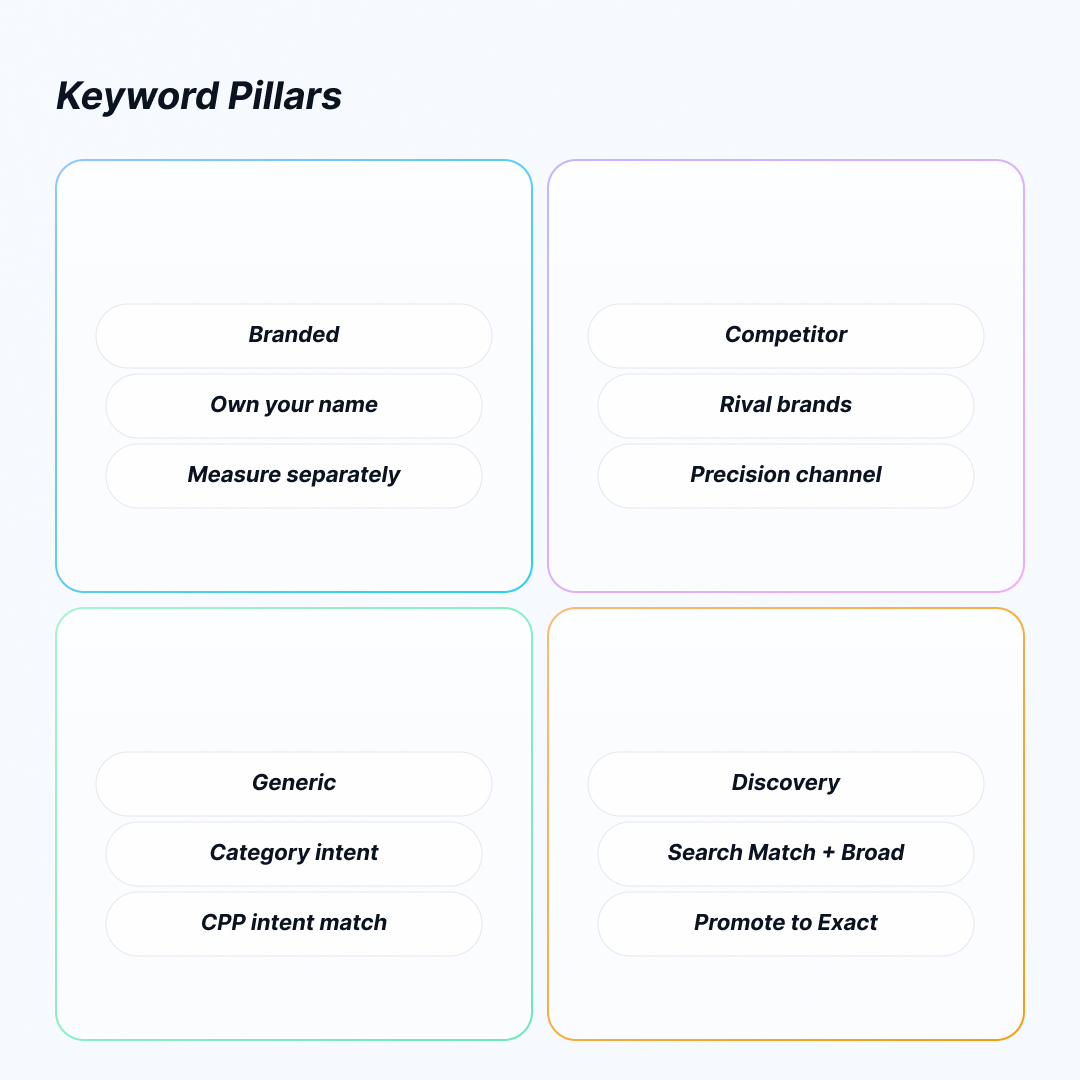
Branded: This covers every way people refer to you. Include your app name, company name, abbreviations, and misspellings. It is high intent and usually the cheapest. Measure it separately to see the demand you already own. Your goal is simple. Hold the top spot on your name and remove friction.
Competitor: This targets rival brands and “alternative to” searches. It costs more and converts less than Branded. It can still drive true incremental share if your positioning is sharp. Treat it like a precision channel, not a pride match.
Generic: This captures category and job based searches like “habit tracker” or “learn Spanish.” It is your widest top of funnel. It becomes a growth engine when you control it. Use thoughtful bids, strict negatives, and intent matched Custom Product Pages.
Discovery: This is not a junk drawer. It is a feeder. Run Search Match and broad match with tight cost caps and a firm budget limit. Use it to find queries you did not list. When a query proves itself, move it to exact match in the right pillar. Exclude it from Discovery to keep paths clean.
Competitor: This targets rival brands and “alternative to” searches. It costs more and converts less than Branded. It can still drive true incremental share if your positioning is sharp. Treat it like a precision channel, not a pride match.
Generic: This captures category and job based searches like “habit tracker” or “learn Spanish.” It is your widest top of funnel. It becomes a growth engine when you control it. Use thoughtful bids, strict negatives, and intent matched Custom Product Pages.
Discovery: This is not a junk drawer. It is a feeder. Run Search Match and broad match with tight cost caps and a firm budget limit. Use it to find queries you did not list. When a query proves itself, move it to exact match in the right pillar. Exclude it from Discovery to keep paths clean.
Account Layout that Stays Steady at Scale
Make one campaign per pillar for each market (or per market tier when economics are similar). Inside each campaign, split ad groups by match type: Exact for proven terms with tailored CPPs, Broad for exploration under stricter CPTs and negatives. Keep Search Match only in Discovery.
If you combine countries into a tiered campaign, watch CPP localization, reporting currency, and pacing across time zones. If you need separate budgets or have legal/reporting constraints, mirror the same pillar structure per country and manage budget at campaign level.
Match Types, Routing, and Why Negatives Matter
ASA broad match can pull close variants, synonyms, and spelling errors. That’s useful for learning and dangerous for routing. Use campaign-level negatives to enforce the separation between pillars, and ad-group negatives to manage match-type control within a pillar.
Remember ASA supports exact-negative and broad-negative: use exact-negatives for specific phrases, and broad-negatives when you need umbrella blocks.
Remember ASA supports exact-negative and broad-negative: use exact-negatives for specific phrases, and broad-negatives when you need umbrella blocks.
A simple rule set:
- Brand terms as exact-negatives in Competitor and Generic.
- Competitor names as broad-negatives in Branded to force “X vs You” into Competitor.
- Top generic heads as broad-negatives in Competitor once they live as exact in Generic.
- In Discovery, exclude every exact keyword already promoted to a pillar, plus any recurring waste.
Building Keyword Sets that Actually Learn
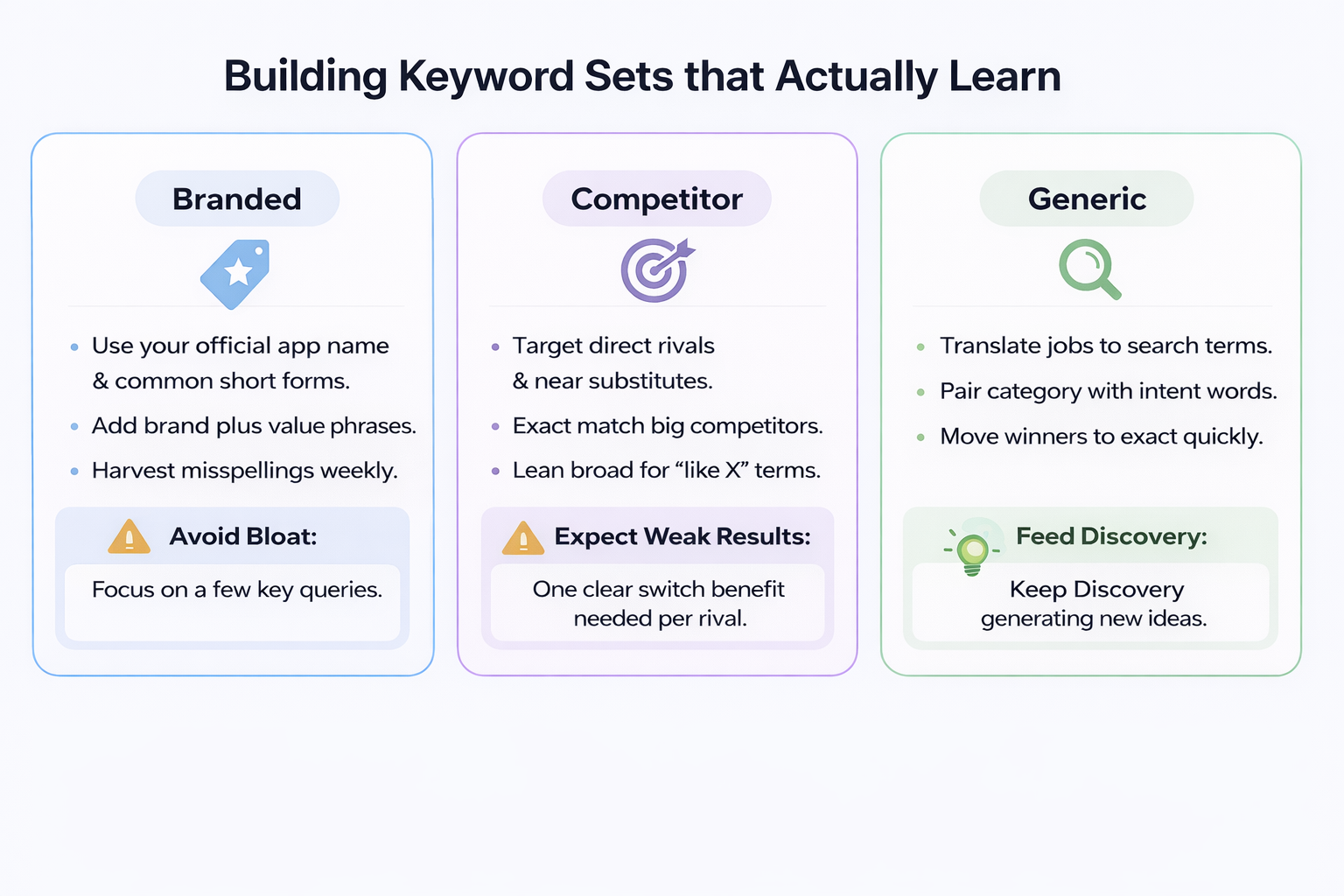
Branded: Start with your official app name and common short forms. Add brand plus value phrases people already type. Harvest misspellings from Search Terms each week. Most brand volume comes from a few queries. Avoid bloat.
Competitor: Prioritize direct rivals, then near substitutes. Put the biggest names in exact match. Keep a lean broad group for the tail and “like X” phrasing. Performance depends on message fit as much as bids. If you cannot state one clear switch benefit per rival, expect weak results until you can.
Generic: Translate jobs to be done into search language. Pair category terms with intent words like “best,” “offline,” “free trial,” “for teams,” or “for kids.” Move winning phrases to exact match quickly. This lets you raise CPT with confidence and attach the right CPP. Keep Discovery feeding new ideas.
Competitor: Prioritize direct rivals, then near substitutes. Put the biggest names in exact match. Keep a lean broad group for the tail and “like X” phrasing. Performance depends on message fit as much as bids. If you cannot state one clear switch benefit per rival, expect weak results until you can.
Generic: Translate jobs to be done into search language. Pair category terms with intent words like “best,” “offline,” “free trial,” “for teams,” or “for kids.” Move winning phrases to exact match quickly. This lets you raise CPT with confidence and attach the right CPP. Keep Discovery feeding new ideas.
Creatives and CPPs Mapped to Intent

Goals, Bidding, and How ASA Actually Optimizes
Apple Search Ads runs on CPT. You can set a CPA goal at the ad-group level to guide delivery.
ROAS, payback (D7/D30), and LTV are business metrics you calculate in your analytics or MMP. They are not built-in bid strategies.
Set a guardrail for each pillar. Choose a CPA target, D7 payback, or ROAS. Convert that target into starting CPTs.
Expect Branded to handle higher CPTs because tap-to-install rates are strong. Start Generic with lower CPTs. Put Competitor in between.
Fix efficiency with bids and creative fit first. Budgets control volume at the current efficiency. Bids control the efficiency itself.
ROAS, payback (D7/D30), and LTV are business metrics you calculate in your analytics or MMP. They are not built-in bid strategies.
Set a guardrail for each pillar. Choose a CPA target, D7 payback, or ROAS. Convert that target into starting CPTs.
Expect Branded to handle higher CPTs because tap-to-install rates are strong. Start Generic with lower CPTs. Put Competitor in between.
Fix efficiency with bids and creative fit first. Budgets control volume at the current efficiency. Bids control the efficiency itself.
Budget Split that Adapts Fast
Start with a role-based plan: protect, win, and grow. Branded protects demand you already own. The competitor wins shares from rivals. Generic grows reach in your category.
As a baseline in a mature market, split spend like this: 25% Branded, 25% Competitor, 50% Generic plus Discovery. Then adapt to context.
For a new app, lean into Generic and Discovery to find intent. Shift toward Branded as your share of search grows.
For a market leader, Branded may need little spend to hold rank one. Push budget into Generic exact to expand profitable reach.
In rival-heavy moments, make short, careful pushes in Competitor. Run 30 to 40 percent for a week. Cut fast based on CPA and downstream value.
During peak weeks, buffer Branded to defend rank one. Increase Generic to capture undecided demand.
Treat Discovery as a hard-capped feeder. Keep it to about 10 to 20 percent of your Generic budget and set a daily cap. Promote winners two or three times per week.
Use a clear graduation rule. Move a query to exact in its pillar after at least 25 installs in seven days at or below target CPA. Add it as a negative back to Discovery to keep routes clean.
As a baseline in a mature market, split spend like this: 25% Branded, 25% Competitor, 50% Generic plus Discovery. Then adapt to context.
For a new app, lean into Generic and Discovery to find intent. Shift toward Branded as your share of search grows.
For a market leader, Branded may need little spend to hold rank one. Push budget into Generic exact to expand profitable reach.
In rival-heavy moments, make short, careful pushes in Competitor. Run 30 to 40 percent for a week. Cut fast based on CPA and downstream value.
During peak weeks, buffer Branded to defend rank one. Increase Generic to capture undecided demand.
Treat Discovery as a hard-capped feeder. Keep it to about 10 to 20 percent of your Generic budget and set a daily cap. Promote winners two or three times per week.
Use a clear graduation rule. Move a query to exact in its pillar after at least 25 installs in seven days at or below target CPA. Add it as a negative back to Discovery to keep routes clean.
Rebalancing Loop
Run a simple weekly loop:
- Impression share / rank on top brand clusters (hold rank one).
- CPA (or D7 payback) by pillar and by match type.
- Discovery → exact graduation count and cost of learning.
- CPP/creative fit: which exact groups outperform when mapped 1:1.
Actions in order: fix routing with negatives → tighten/raise CPTs where justified → align CPPs → only then shift budgets. Daily, skim pacing vs. plan, ensure no pillar is budget-capped at midday, and scan Search Terms for leaks. Move money on stable, repeated signals, not day-to-day noise.
Pitfalls that Quietly Drain Spend
- Search Match outside Discovery. It explodes routing variance. Keep it only in Discovery with strict caps and negatives.
- Creative mismatch. Competitor queries landing on a generic homepage pay conquest prices for lukewarm installs. Map CPPs to intent.
- Duplicate queries across pillars. Use campaign-level negatives to guarantee a single home per query.
- Budget chasing. Don’t swing budgets to chase yesterday’s spike. Tune CPTs and relevance first. Shift budget after stability appears.
FAQs
What Are the Core Campaign Pillars in ASA Search Results?
Branded, Competitor, and Generic. Each captures a distinct level of intent and deserves its own budget, bids, negatives, and CPPs. Discovery is a separate feeder that uses Search Match and broad to find candidates to promote.
How Should I Split the Budget to Start?
Begin with 25% Branded, 25% Competitor, 50% Generic + Discovery. Then rebalance weekly based on CPA/payback and impression share on brand. New apps bias to Generic + Discovery. Established leaders bias to Generic exact.
Exact vs. Broad vs. Search Match - When to Use Which?
Use Exact for proven terms you can map 1:1 to CPPs. Use Broad to explore close variants and synonyms under tighter CPTs and negatives. Keep Search Match only in Discovery with a hard budget cap.
How Do I Prevent Cannibalization Between Pillars?
Route with negatives: brand terms as exact-negatives in Competitor/Generic. Competitor heads as broad-negatives in Branded. Promoted generic heads blocked broadly in Competitor. In Discovery, negative every keyword you’ve graduated.
Does ASA Optimize to ROAS?
ASA bids are CPT with optional CPA Goal at the ad-group level. ROAS/payback/LTV are business metrics you calculate in your analytics stack. Use them to set guardrails and inform CPTs and budget, but they’re not built-in bid strategies.
Conclusion
In the end, ASA does not scale because you raise bids. It scales because the system stays readable. When you separate Branded, Competitor, and Generic into clear lanes, keep Discovery as a capped feeder, and enforce routing with negatives, you remove noise and unlock predictable optimization.
From there, growth becomes a disciplined loop. Map intent one to one to creatives and CPPs, graduate winners into exact, and rebalance weekly based on CPA or payback and impression share. Done consistently, this structure protects brand demand, captures incremental share from competitors, and turns generic search into a durable engine for profitable scale.
From there, growth becomes a disciplined loop. Map intent one to one to creatives and CPPs, graduate winners into exact, and rebalance weekly based on CPA or payback and impression share. Done consistently, this structure protects brand demand, captures incremental share from competitors, and turns generic search into a durable engine for profitable scale.