
Product: mobile app in the fitness category (yoga)
Platform: Google Play
Markets covered: the US, UK, Mexico, Russia, Germany, and Brazil, with expansion into Sweden, Japan, and Hungary.
Platform: Google Play
Markets covered: the US, UK, Mexico, Russia, Germany, and Brazil, with expansion into Sweden, Japan, and Hungary.
Goal
Restore and grow organic installs after a sharp drop in visibility, while also building a more predictable ASO iteration process and a structured approach to creative testing.
Context
At the end of November, before our first ASO iterations had even begun, Google Play went through a keyword reindexation. As a result, rankings dropped sharply across a broad set of queries, both branded and generic, and did not fully recover.
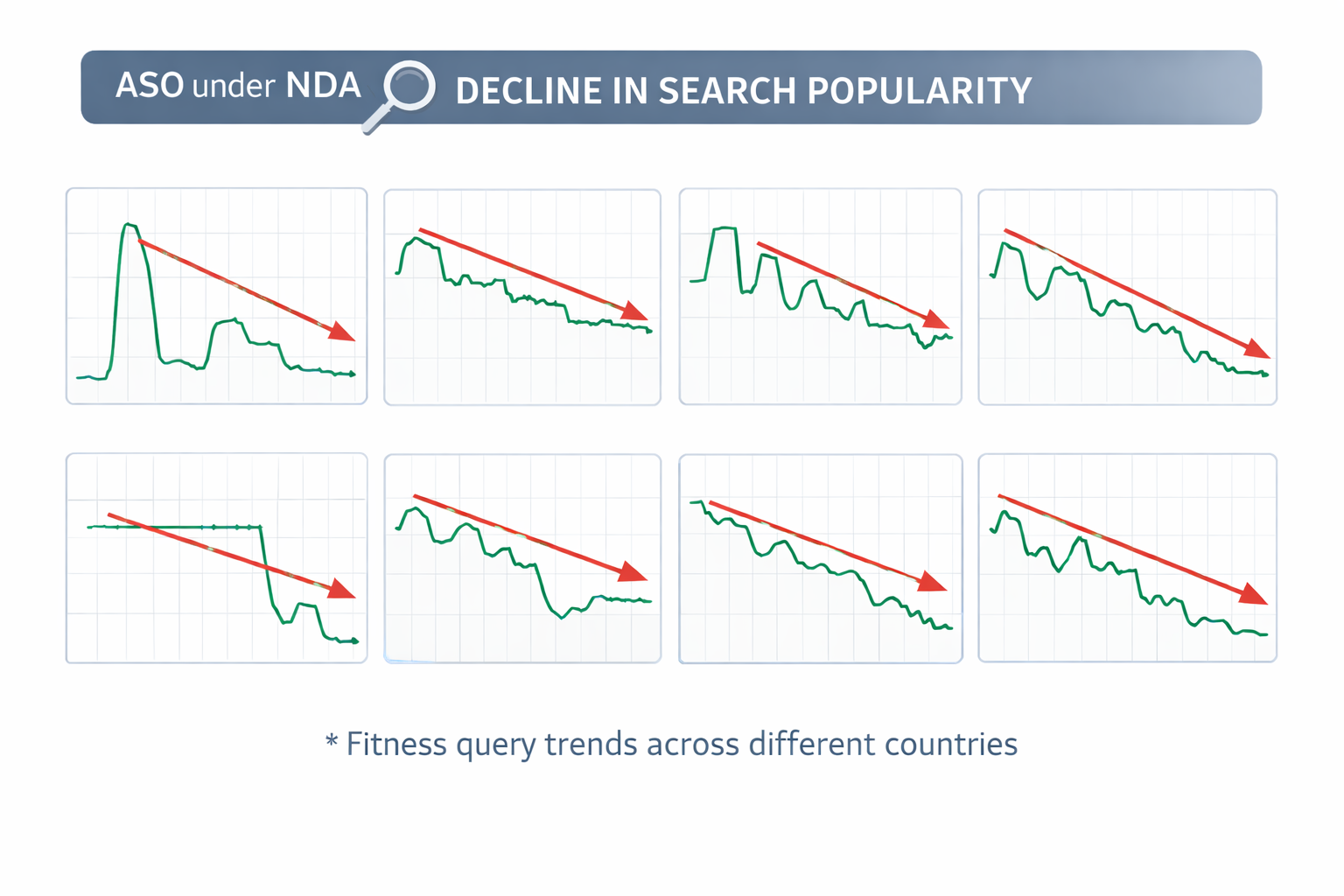
At the same time, the market showed a clear decline in fitness-related search demand across multiple countries, while competition in the category remained high.
This was a critical factor. In a situation like this, even strong ASO improvements can help recover visibility and rankings, but they cannot guarantee install growth when overall demand is falling.
At the same time, the market showed a clear decline in fitness-related search demand across multiple countries, while competition in the category remained high.
This was a critical factor. In a situation like this, even strong ASO improvements can help recover visibility and rankings, but they cannot guarantee install growth when overall demand is falling.
What we did
We split the work into two parallel tracks: tactical visibility recovery and strategic validation of the category’s future potential.
1. Metadata iterations and semantic expansion
We focused on core category queries related to yoga, as well as adjacent keyword groups such as “for beginners” and “asanas,” to regain indexing and partially recover rankings. In the US, we worked through both the main locale and an additional one.
2. Geo-expansion through localization
Since some markets had no localization in place before, we launched ASO iterations in new locales including Hungary, Sweden, and Japan. This helped us gain indexing for new keywords and improve visibility. Due to reporting delays in the console, the install impact was expected to carry over into the following reporting period.
3. Custom Store Listings for specific keyword cohorts
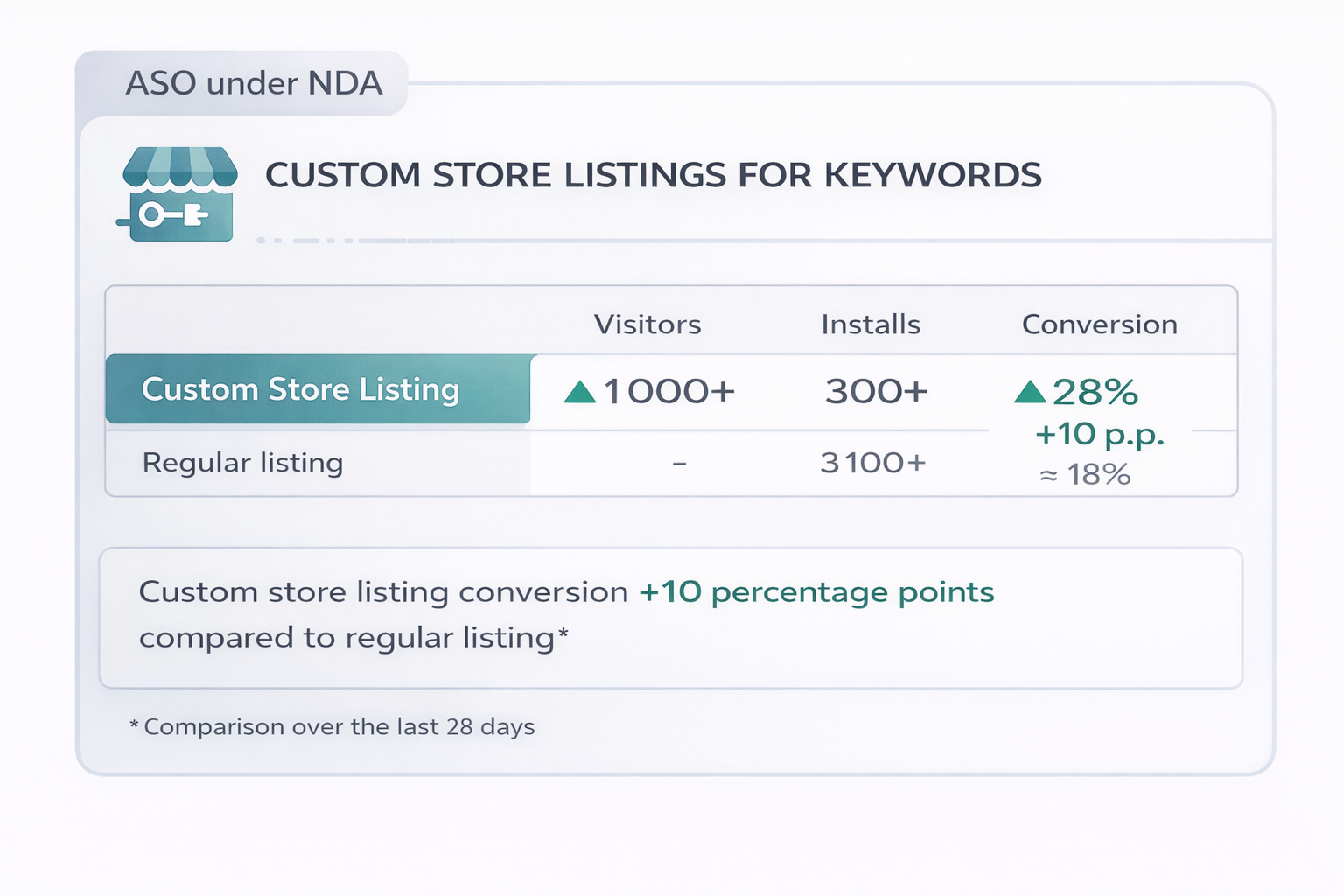
We launched and expanded Custom Store Listings for English-speaking markets to better match user intent and improve landing-page relevance for specific keyword clusters.
4. A/B testing of creative assets
We continued testing the icon and visual assets, scaling experiments only after confirming hypotheses on a sufficient traffic volume.
1. Metadata iterations and semantic expansion
We focused on core category queries related to yoga, as well as adjacent keyword groups such as “for beginners” and “asanas,” to regain indexing and partially recover rankings. In the US, we worked through both the main locale and an additional one.
2. Geo-expansion through localization
Since some markets had no localization in place before, we launched ASO iterations in new locales including Hungary, Sweden, and Japan. This helped us gain indexing for new keywords and improve visibility. Due to reporting delays in the console, the install impact was expected to carry over into the following reporting period.
3. Custom Store Listings for specific keyword cohorts
We launched and expanded Custom Store Listings for English-speaking markets to better match user intent and improve landing-page relevance for specific keyword clusters.
4. A/B testing of creative assets
We continued testing the icon and visual assets, scaling experiments only after confirming hypotheses on a sufficient traffic volume.
Results
By the end of the period, the picture was clear: the market was working against the category.
Over the last 28 days, organic traffic in the yoga app category declined by 16.6%.
Comparing November 2025 (before ASO) with January 2026 (after two months of ASO), Explore installs worldwide fell by 15.81%, while store listing visitors declined by 1.84%.
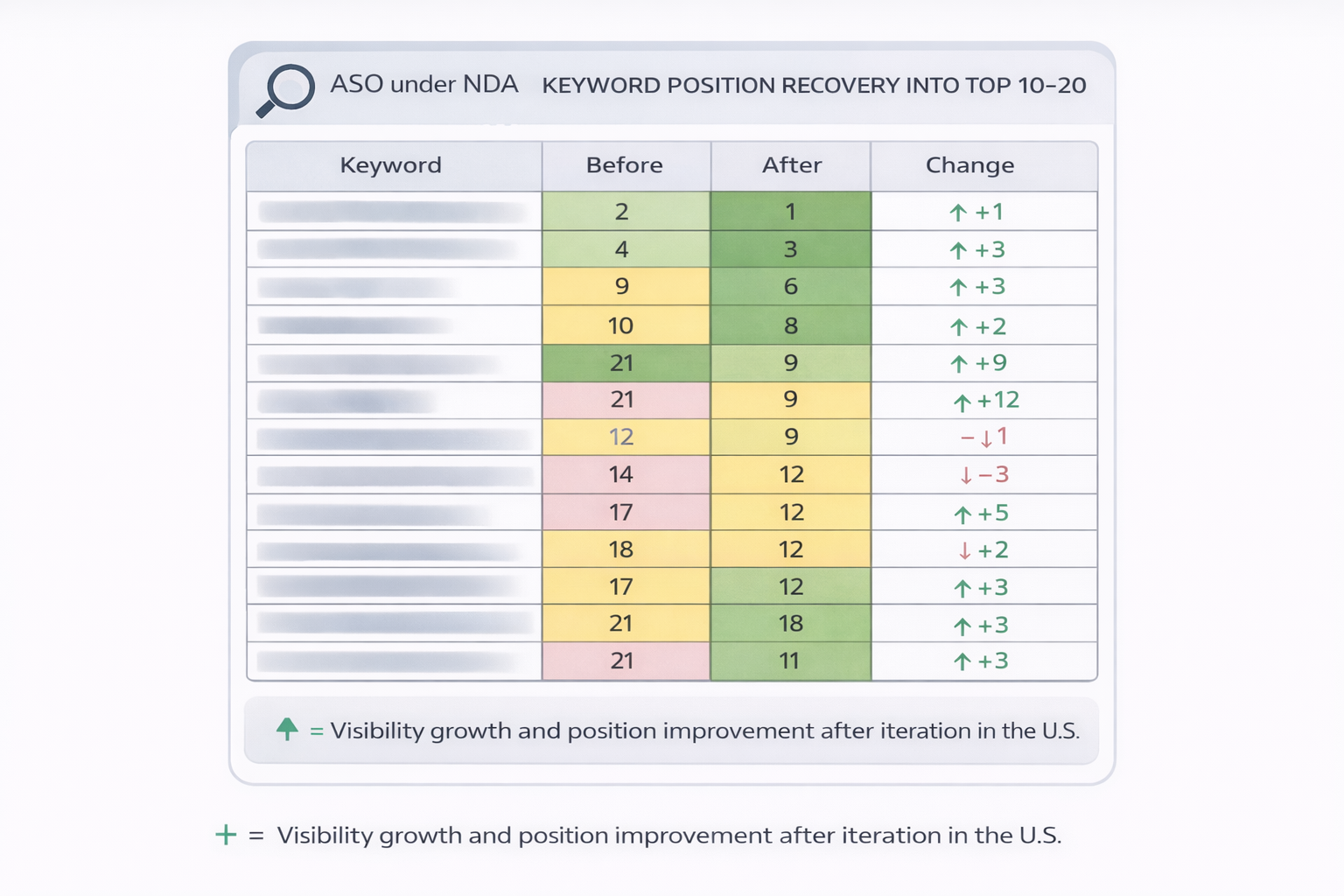
At the same time, in the US we saw some keywords return to the top 10–20, along with visibility growth across part of the semantic core. In other words, ASO helped support rankings and recover part of the lost visibility, but overall install volume remained constrained by declining demand.
Over the last 28 days, organic traffic in the yoga app category declined by 16.6%.
Comparing November 2025 (before ASO) with January 2026 (after two months of ASO), Explore installs worldwide fell by 15.81%, while store listing visitors declined by 1.84%.
At the same time, in the US we saw some keywords return to the top 10–20, along with visibility growth across part of the semantic core. In other words, ASO helped support rankings and recover part of the lost visibility, but overall install volume remained constrained by declining demand.
Conclusion
Instead of trying to force growth in a category with weakening demand, we recommended reallocating part of the effort toward a more promising health-focused app centered on health metrics tracking.
For the yoga app, we kept a support-level ASO strategy in place: ongoing monitoring, selective metadata iterations, CSL optimization, and continued A/B testing of creative assets.
For the yoga app, we kept a support-level ASO strategy in place: ongoing monitoring, selective metadata iterations, CSL optimization, and continued A/B testing of creative assets.
What’s next
For the yoga app, we are continuing to monitor indexing after reindexation, run targeted metadata updates, test creative assets, and refine CSLs, but without overstating growth expectations until market demand begins to recover.