
Platforms: App Store + Google Play
Project period: January to October 2025
Focus markets: United States, Canada, United Kingdom, Australia
Project period: January to October 2025
Focus markets: United States, Canada, United Kingdom, Australia
Project overview
Client: a mobile app in the Fashion & Style category.
Goal: grow organic traffic and visibility in key English-speaking markets and scale results through locale expansion.
Goal: grow organic traffic and visibility in key English-speaking markets and scale results through locale expansion.
Objectives
We focused on three areas:
- Organic growth: increase organic impressions, app page views, and installs in priority markets.
- Stronger keyword coverage: expand the semantic core and increase the number of keywords for which the app ranks in the top 30.
- Systematic store iterations: update localizations, test creatives, and use store features and in-app events.
What we did
ASO strategy and iterations
We worked iteratively and updated metadata and locales on a regular basis to expand coverage for relevant keywords and sustain visibility growth. In the US, iterations were carried out monthly, while additional locales were also optimized.
Geo expansion and localizations
Alongside the existing target markets, we expanded visibility through new locales. During the project period, iterations were carried out across 18 locales, including additional ones. This approach improved keyword indexing not only in the focus markets, but also across a number of other regions.
A/B testing of creatives and store features
We ran A/B tests for icons and screenshots and launched store listing features:
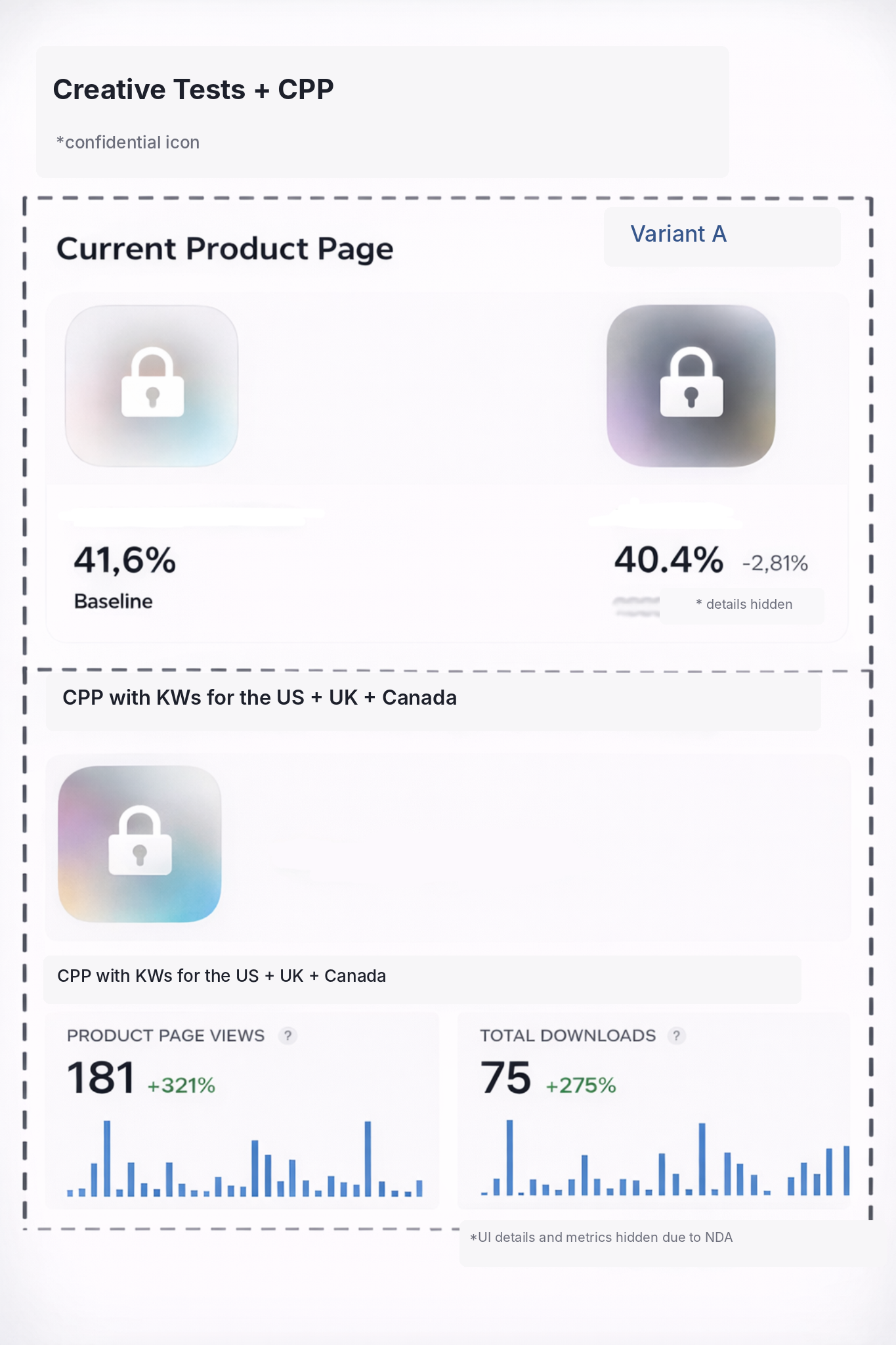
- App Store: over the full project period, we ran 21 A/B tests. One icon variant showed improvement, but it was not implemented on the client side. We also launched CPPs.
- Google Play: we tested icons and screenshots and launched CSLs. In the US, data was limited due to low volume.
In-App Events (App Store)
We launched 11 in-app events, which generated around $5,000 in total. The best-performing format was a video event. We also identified video events as a promising format for attracting a more engaged audience.
Competitor analysis and market prioritization
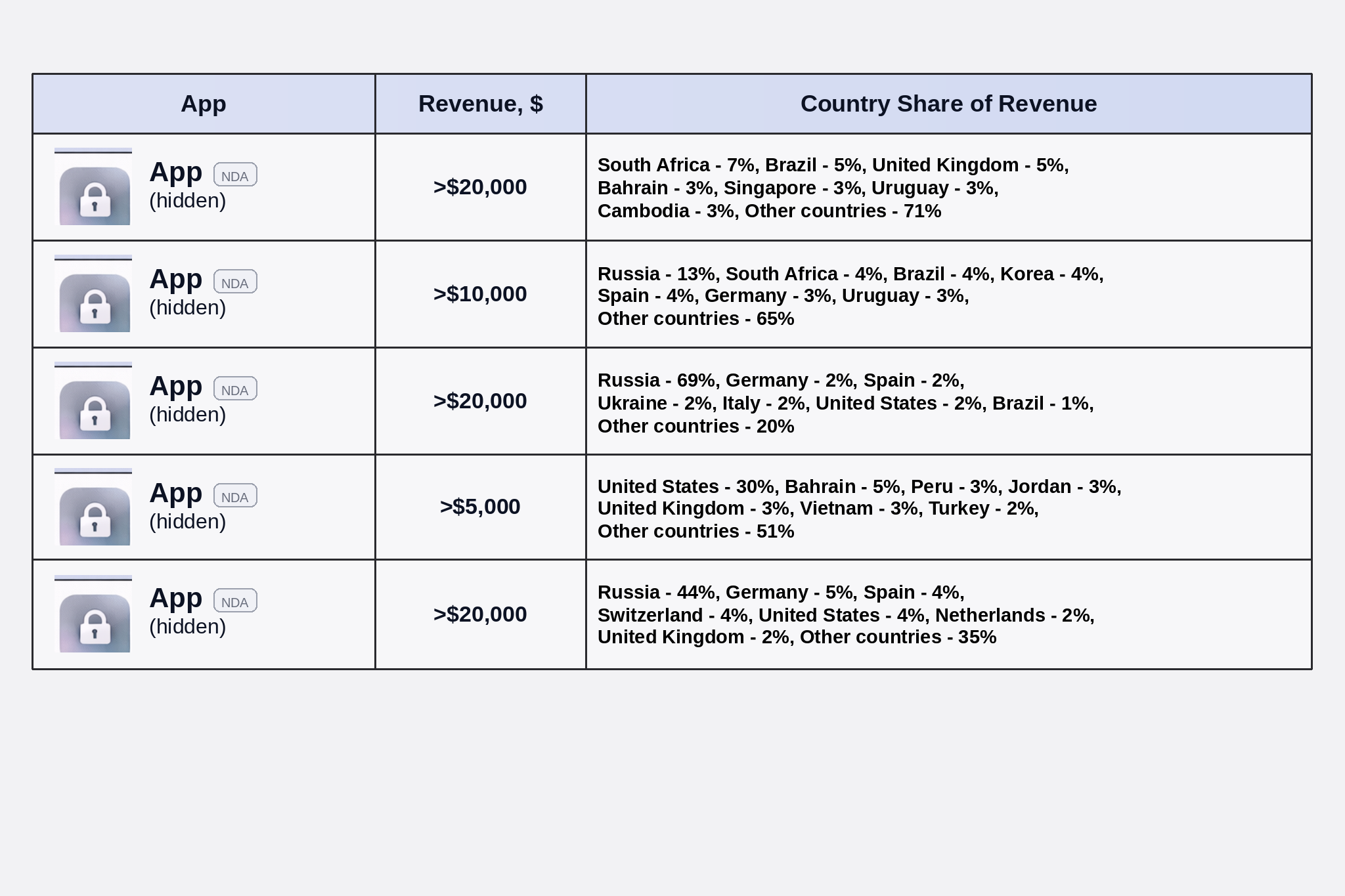
We analyzed how competitors' revenue was distributed across countries and used this as one of the inputs for selecting and prioritizing target markets.
Results
App Store
Growth in key markets across impressions and first-time installs. October data is shown excluding ASA traffic.
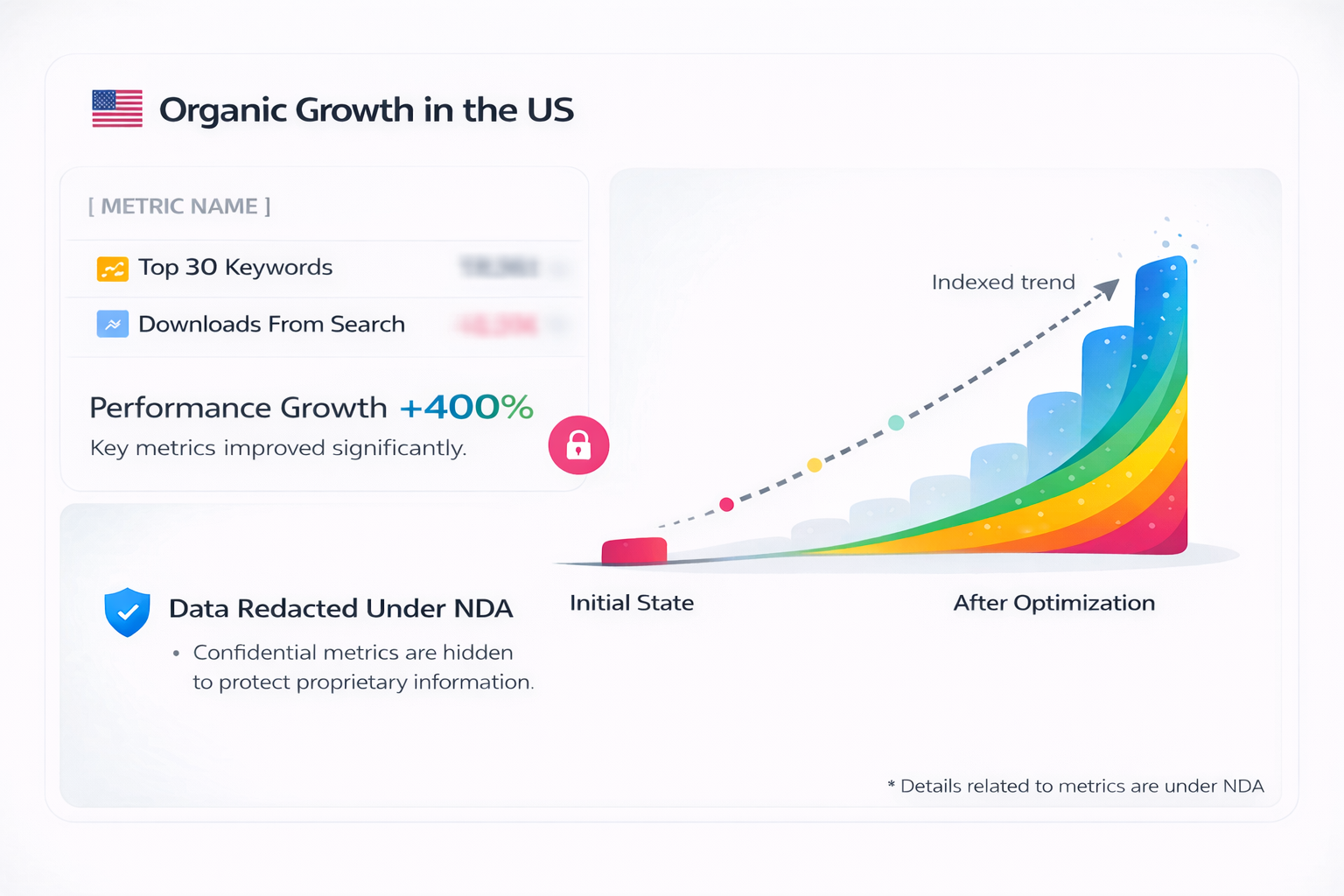
- Worldwide: first-time installs +996.6%, impressions +1386.1%
- United States: first-time installs +2848.5%, impressions +2076.46%. Top 30 keyword coverage grew from 24 to 516 keywords
- Canada: first-time installs +803.17%, impressions +1486.2%. Keyword coverage grew from 72 to 164
- United Kingdom: first-time installs +493.58%, impressions +2126.8%. Keyword coverage grew from 52 to 304
- Australia: first-time installs +145.75%, impressions +518.72%. Keyword coverage grew from 42 to 129
Google Play
- Worldwide: acquisitions +1428%, visitors +7072%
- United States: acquisitions +4733%. Keyword coverage grew from 4 to 2730 keywords
We also recorded keyword indexing growth in a number of less obvious markets, including Germany, Brazil, and Spain. This reflects the impact of the geo-expansion and scalable localization strategy.
What makes this case important
The growth did not come from one magical update, but from systematic work: semantic expansion, regular locale iterations, and continuous hypothesis testing.
At the same time, some creative tests did not deliver uplift. That is a normal part of valid optimization and a foundation for the next round of iterations.
At the same time, some creative tests did not deliver uplift. That is a normal part of valid optimization and a foundation for the next round of iterations.
Next steps
- Monitor crash rate and ANR, as both affect store quality signals and ranking
- Increase the average rating through review analysis and product fixes
- Reassess paid traffic distribution in Google Play to eliminate inefficient scenarios
- Consider launching Google App Campaigns as a channel for scaling high-quality reach