Platforms: App Store and Google Play
Period: April to December 2025
Period: April to December 2025
Project overview
We worked on ASO for a mobile app in the Business / Productivity category, focused on digital business cards and contact sharing.
The goal was to grow organic visibility and first-time installs across priority markets, while also improving conversion through creative testing and store-native tools. The project covered both the App Store and Google Play and ran from April to December 2025.
The goal was to grow organic visibility and first-time installs across priority markets, while also improving conversion through creative testing and store-native tools. The project covered both the App Store and Google Play and ran from April to December 2025.
Goals
At the start of the project, we focused on four main objectives:
- increasing organic traffic and first-time installs from search
- expanding visibility in priority countries through localization and indexing
- improving conversion through creative optimization
- keeping only the changes that produced measurable results.
What we did
Metadata and localizations
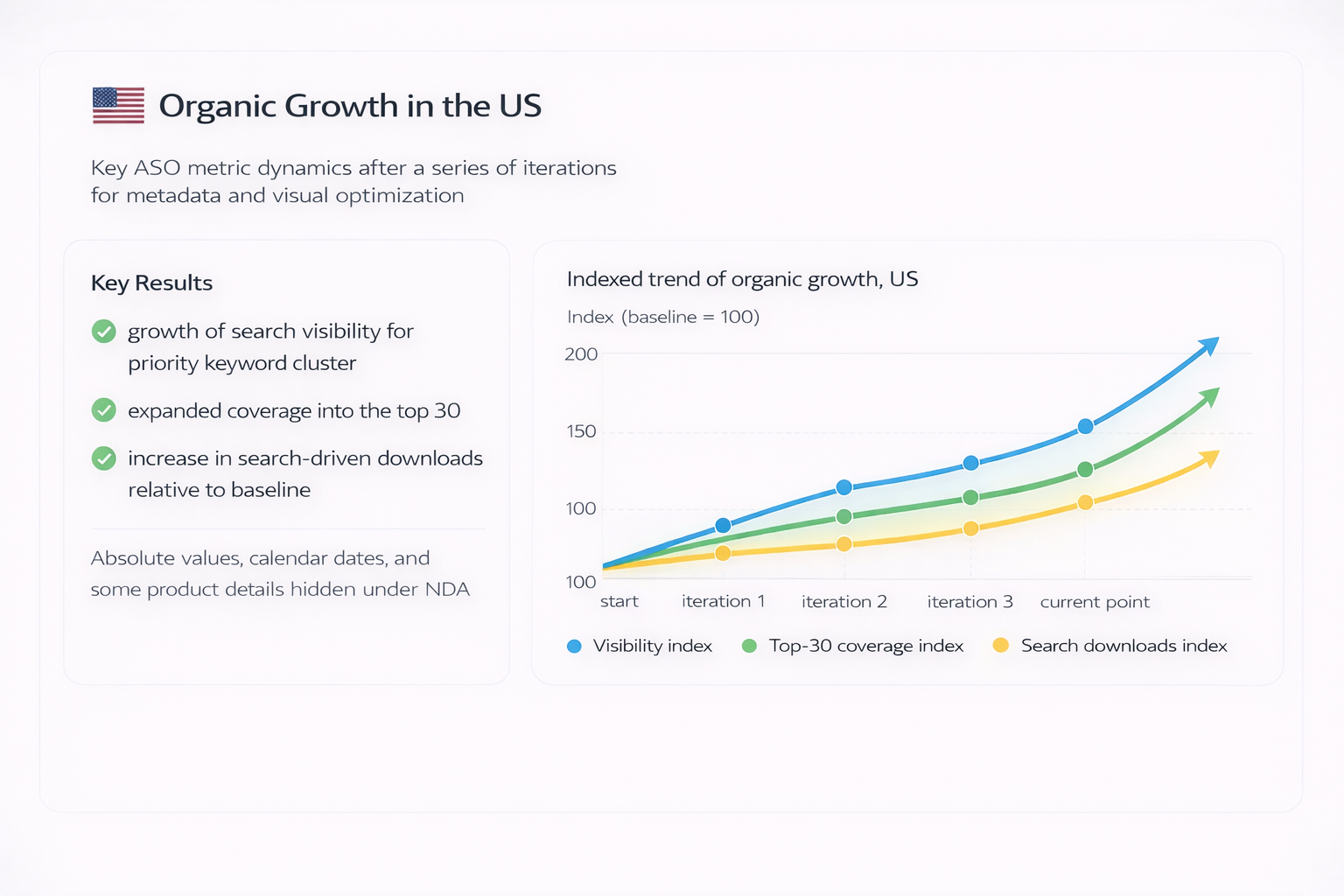
We continuously updated the semantic core and metadata by country, strengthening local keyword coverage, expanding the pool of indexed queries, and tracking rankings and their contribution to installs. Particular attention was given to the US as a core market, while additional locales were used to scale growth across other regions.
Focused on visibility growth through indexing and rankings
A major part of the strategy was increasing search coverage and improving positions for relevant high-potential keywords, including both generic and branded terms. This helped the app gain more visibility across key markets and laid the foundation for long-term organic growth.
At the same time, we closely monitored the limits of growth. In several locales, some important keywords were still ranking outside the top 10, which meant visibility increased faster than conversion.
At the same time, we closely monitored the limits of growth. In several locales, some important keywords were still ranking outside the top 10, which meant visibility increased faster than conversion.
Added store-native growth tools
To strengthen the organic strategy, we launched and evaluated several additional tools.
- On Google Play, we used Custom Store Listings (CSL) to create separate listing variations for specific user intents and scenarios, including returning users.
- On the App Store, we implemented Custom Product Pages with keywords (CPP with KWs), allowing us to capture additional organic traffic through keyword-linked custom pages.
- We also tested In-App Events on the App Store, running a series of event concepts with different titles and measuring their impact on conversion over time.
Continued creative testing
We reviewed previous test history, kept only the strongest-performing concepts in the working roadmap, and generated new hypotheses based on the results. This included structured testing of screenshots and icon variations to improve store conversion.
Results
App Store
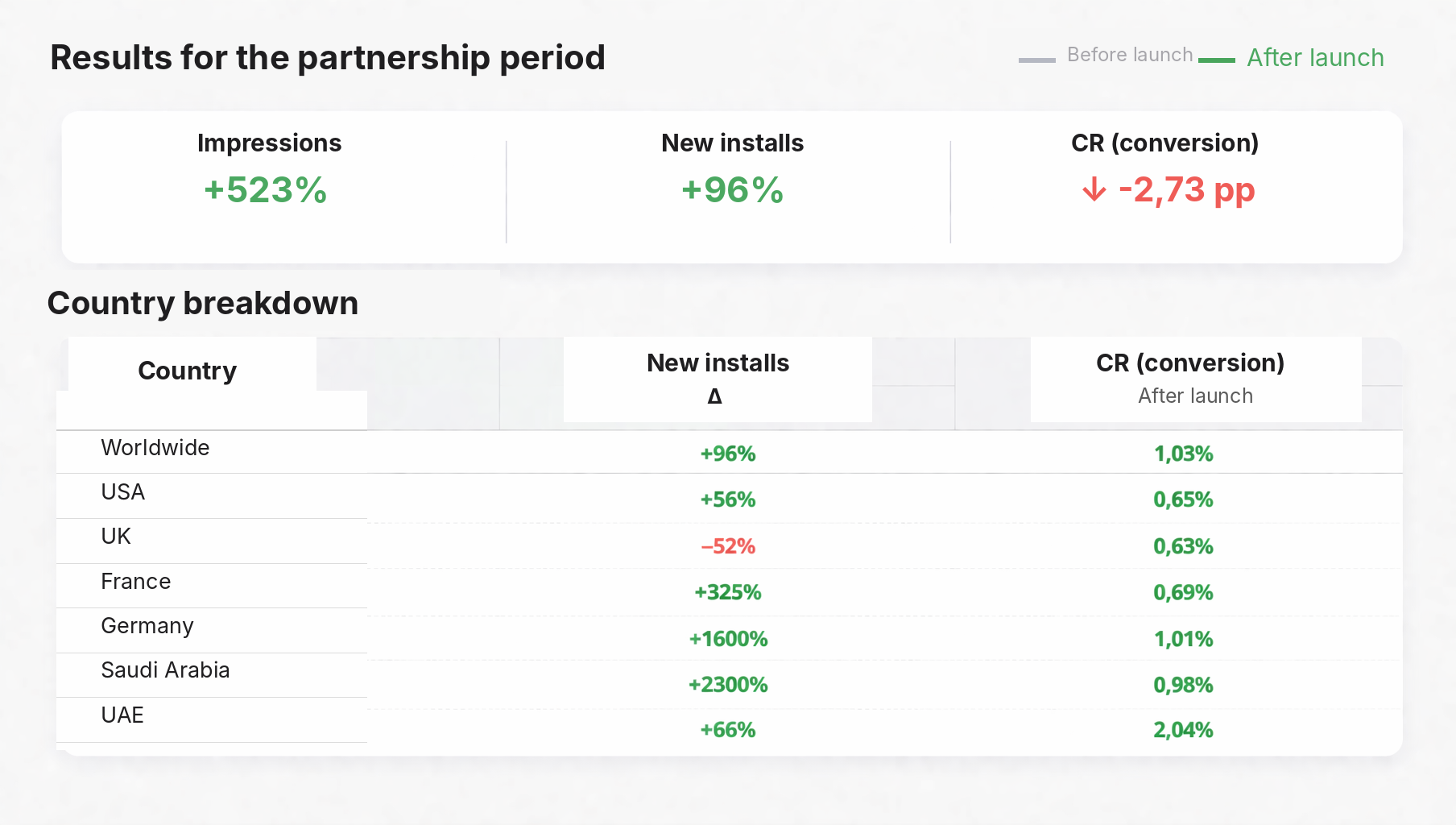
During the partnership period, organic first-time installs on the App Store grew by 96.3% worldwide compared to the previous equivalent period. In the US, first-time installs increased by 56%.
This growth was supported by strong gains in search visibility across key countries:
In some countries, visibility grew faster than conversion, since a meaningful share of indexed keywords had not yet reached top positions. This gave us a clear direction for the next iteration cycle.
This growth was supported by strong gains in search visibility across key countries:
- Worldwide: impressions +522.9%, first-time installs +96.3%
- France: impressions +2011%, first-time installs +325%
- Germany: impressions +3925%, first-time installs +1600%
- Saudi Arabia: impressions +6440%, first-time installs +2300%
- UAE: impressions +1602%, first-time installs +66%
In some countries, visibility grew faster than conversion, since a meaningful share of indexed keywords had not yet reached top positions. This gave us a clear direction for the next iteration cycle.
Google Play
On Google Play, organic first-time installs grew by 9.3% across all countries during the project period.
In the US, December performance declined by 25.5%, which we linked to seasonal demand shifts during the holiday period.
In the US, December performance declined by 25.5%, which we linked to seasonal demand shifts during the holiday period.
Store tools and experiments
Several store-native tools made a measurable contribution:
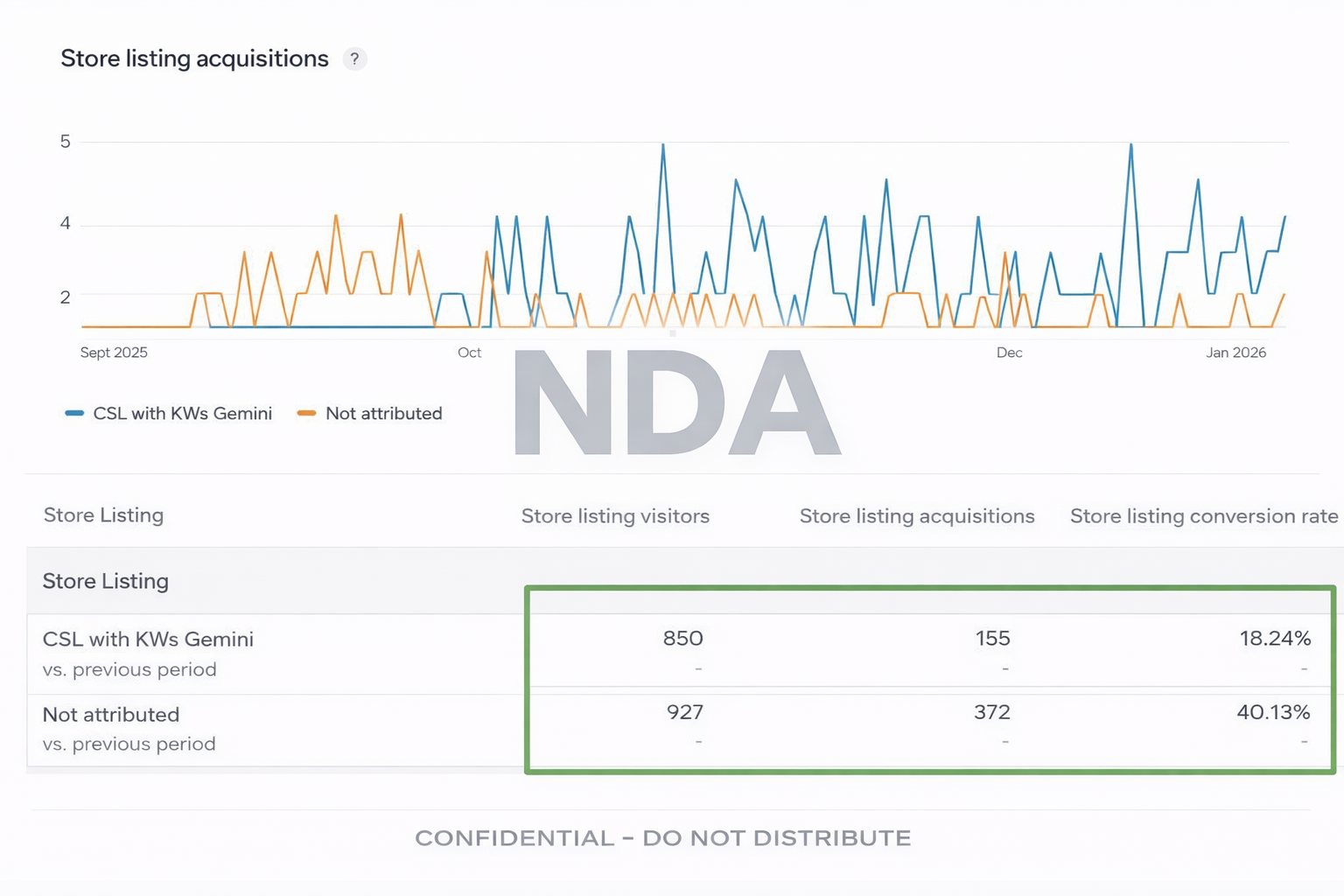
- A Google Play CSL for returning users generated 372 installs with a 40.13% conversion rate
- Keyword-based CSLs generated 155 installs with an 18.24% conversion rate
- App Store CPP with KWs generated 40 installs during the project period, with the strongest contribution coming from Saudi Arabia, Mexico, Germany, Russia, and France
- An App Store screenshot A/B test delivered a +12.63% uplift in conversion, and the winning version was implemented
- On Google Play, we tested icon variations, stopped weak options, and kept the best-performing creative based on the latest results
Why it worked
The project was built around continuous iteration and data-backed decision-making.
Every hypothesis was validated through rankings, indexing, conversion data, and contribution to organic growth before being scaled. We did not treat ASO as a one-time metadata update. Instead, we combined semantic expansion, localization, creative testing, and store-native tools into a repeatable growth system.
This approach made it possible not only to improve visibility, but also to understand which levers had the strongest impact in each market and on each platform.
Every hypothesis was validated through rankings, indexing, conversion data, and contribution to organic growth before being scaled. We did not treat ASO as a one-time metadata update. Instead, we combined semantic expansion, localization, creative testing, and store-native tools into a repeatable growth system.
This approach made it possible not only to improve visibility, but also to understand which levers had the strongest impact in each market and on each platform.
Next steps
The next stage of growth is focused on moving more priority keywords into the top 10, scaling CSL and CPP strategies across new markets and keyword clusters, continuing creative A/B testing based on the accumulated learnings, and further testing In-App Events to build a more reliable performance benchmark over time.